Showing posts with label beans. Show all posts

22 October 2014

Warm Season Garden Planning. Warm Weer Tuin Beplanning

Welcome to my second instalment of fruit and veg garden planning. The last time I blogged about garden planning it was the beginning of our southern autumn and I was very hopeful and excited about the possibilities of my cold season garden. This time around I'm blogging midway through the spring, so therefore this post is about planning for warm planting season.

The success of my winter garden was a mixed bag of welcome delights and bitter disappointments. I can quite happily state though, that the failures in my winter garden was less to do with inadequate planning and more to do with being over-enthusiastic. Yes, once again I made some mistakes in my garden, but I will post on this in future. This post is about informing you on my plans for my three main fruit and veg beds, and the subsequent exertion put into getting ready for the summer season.


Backyard veg patch worked over and ready for compost/Agterplaas groentetuin is omgespit en gereed vir kompos


Calculating how much space you have

This season I spent the least amount of time on this step. You see; I have a mild case of OCD so I spent hours upon hours of measuring, re-measuring, calculating and re-calculating the size of all my beds in March of this year. This time around I just pulled up my Excel spreadsheet... and Bob's your uncle! I will admit that it took some minor fiddling here and there as my calculations were a bit off last time. As I am ever the perfectionist, this minor error had to be fixed. Just Had to!

The total size of my three main beds is 12.84m2 of which 7.72m2 is usable for fruit and veg production. This is due to certain areas being in the deep shade during certain periods of the day, or simply by perennials taking up the space. I know my space is severely limited, but one has to work with what one has, hey?


Deciding on which veggies or varieties to grow

Which summer fruit and veggies do we like to eat most?

If I go according to that list, my planning measures up in the following way: 
I already have a Granny Smith apple in my fruit bed. It's been in my garden about a year and a half and still going strong, but won't bear fruit for a while yet. I already bought my baby marrow (courgette/zucchini) seed at our local Agri store, but won't do butternuts again as they take up too much space. I also already have my dry beans, ready to be sowed. They're leftovers from last year's planting season. I don't have enough space for either cucumbers or grapes, so will still have to source those from our fantastic local fresh produce store, but the peppers were left in my garden. I treat them as perennials since they die back almost completely in the cold season, but always come back into their own late September. I saved three of the sweet potatoes I harvested from the garden in April to make new slips with. Currently the slips are beautiful, and forming roots in a little plastic tub filled with rain water. Tomatoes? I purchased twelve Moneymaker seedlings and cherry tomato plants from local nurseries. 
Sweet potato slips/Patatranke
Which fruit and vegetables worked in my garden last spring/summer?

Which plants or vegetables benefit most from each other?
Companion planting is a subject every organic backyard farmer must familiarise him/herself with. This is due to the fact that bugs and pests love fresh veggies just as much as we do, especially in a humid climate like the Garden Route's. I won't spray any (non-organic) pesticides, so the fruit and veggies are even more of a temptation to the little critters. The best way to solve, or at least minimise, this problem is to inter-plant fruit and veggies with beneficial herbs and plants and also plant trap crops like nasturtiums. The former assist and provide nutrition to the fruit and vegetables and the latter draw the pests away from our treasured produce. The idea behind companion planting is to create a small and balanced eco-system in your garden, thereby not providing fodder for bugs by planting a ton of the same plant or species. The best South African advice on companion planting is to be found on Livingseeds' website and another good table can be found here.

Which plants are most suited to my soil type and amount of shade?
This is a question that can only be answered with a great degree of certainty after the third or fourth growing season. Yes, as a gardener you will probably know what kind of soil you're blessed (or cursed with), and therefore which fruit and veggies are best suited to your property, but even this knowledge might be misleading. My blessing is the fact that my parents frequently composted in years gone by. My curse is that our natural soil is rich in clay, but luckily the same parentals sorted most of this out by extensively applying lime. I have never actually done a pH test on my soil so I can't say without doubt whether I have acid or loamy soil, but my bet is on good garden soil (somewhere between the two), as it is rich and black in colour (minus the small bits of clay left in some spots underground).

Drawing up a garden plan

I once again used the fantastic GrowVeg Garden Planner tool to assist in this task. This time around I decided to purchase a year-long membership. This enables me to not only draw up multiple garden plans without deleting and re-doing them one by one, but the tool also remember what I planted in a specific space before. This will help me with the next season's planning and planting, as the tool will give me crop rotation warnings etc. Brilliant hey! 

I've decided to share my Backyard Veg Patch plan with my avid blog readers again, if only to show you how the tool assists in the whole process... and how I've improved in utilising it haha. One thing I realised is that you can select the variety as well as the plant type. Practice makes perfect. Without further ado - here is my plan:
Backyard veg patch plan/Agterplaas tuin plan (copyright www.growveg.com)
At least I can say with all honesty that this phase of my planning took a fraction of the time this season. Thank you GrowVeg!

Preparing the soil

As I like to believe I learn from my mistakes, I decided to delay my summer season planting with a month or so this time year. My region experience most rainfall in Oct/Nov and Mar/Apr, although we do get rain most months of the year. Last year the combination of granny's impatience and my eagerness led us to sow and plant most of our warm season crops late August already. Mistake! Not only did some seeds drown in the heavy October rains, but the tomatoes and beans were more susceptible to blight, as the plants which did make it had to struggle through the whole wet season.

This time I only started to prepare my beds early October, and plan to plant my beans, courgettes, sweet potatoes and tomatoes late October. I can almost hear some readers gasp in horror. Surely one cannot sow tomatoes as late as that?! No dear readers, I've also learned from my second mistake - plant seedlings wherever possible and stay away from seeds. I learned this lesson by comparing my tomato production (dismal) to my best friend's 100m away in the same neighbourhood (bountiful). Yes, sometimes one can learn by observation of others.

As stated in my previous post, the MOST IMPORTANT TASK IN GARDEN PLANNING is soil preparation. I'm using upper-case again to emphasise just how important this step is. The two golden rules I've stayed with this year is composting and fertilising.

Unsatisfactory compost mixed with organic manure/Middelmatige kompos gemeng met organiese hoendermis
At the risk of becoming repetitive, the rule of thumb with composting is to add around 2 bags of good, organic compost to every square meter (roughly the equivalent of 2 inches of compost as a top layer). As I wasn't a hundred percent happy with the quality of the compost I purchased for most of my garden (it didn't have the healthy slight farm stink to it and was also too fine for my liking), I decided to add roughly one part pure organic chicken manure to two parts (unsatisfactory) compost. Problem solved. Unfortunately the organic chicken farm where I usually purchase my manure ran out. After briefly wondering how a chicken farm runs out of chicken poo I decided to stock up at the other organic chicken farm in the vicinity. Tip to future buyers from said farm: ask for chicken compost, as the cashier doesn't know it by any other name... and I mean any other. Luckily I also bought four big bags of great, organic compost for my backyard veg patch elsewhere, so those didn't need added manure.
The good stuff - Grow Green Organics compost/Swart goud - Grow Green Organics kompos
A rule of thumb with fertilising is to add about 150g composted chicken manure to every square meter - around fruit trees especially. 50g equals about a handful. A good organic option is either Bounce Back (around R60.00 for a 5kg bag). A cheaper option is Rescue, which is also pelletised chicken manure, but comes in a less snazzy bag. I opted for the latter and bought 4kg for only R40.00 (a 17% saving) at Norgarivier Nusery on the Old Airport Road.

I did most of the composting about a week ago, and did the fruit tree fertilising a few days ago. Now I just have to wait the required two weeks after composting to get in my selected vegetables for the summer season. What did I choose to plant this time around?
  1. Contender bush beans (seed): as they produce quicker than pole beans and don't cast shade on other plants in my very limited gardening space.
  2. Caserta courgettes/baby marrows (seed): as they require a fraction of the space gobbled up by butternuts or other pumpkin varieties
  3. Cucamelons (seed): as they are simply too adorable to resist
  4. Sweet potatoes (slips): after the success of last year I would be crazy not to plant it again!
  5. Cherry tomatoes (seedling): as they grow and produce quickly and are more hardy to diseases than big tomatoes.
  6. Normal sized Moneymaker tomatoes (seedling): the name convinced me ;-)
And that is my summer season garden planning story... in detail... maybe too much detail

(... but who cares...)

26 March 2014

Soul Food: Pumpkin Fritters & Curried Beans. Sielskos: Pampoenkoekies & Kerriebone

I love food. I'm the first person to admit that, but for some reason I have an even greater passion for eating in the colder months. As soon as the leaves turn sunset shades of orange and yellow, I start to get hungry faster, nibble more and over-indulge on a (much more) regular basis. As per normal, the survival mechanism built into humanity since  cavemen days is  conveniently blamed for this turn of events.

I therefore thought it quite appropriate to write a blog post on soul food. Especially, two of my favourite recipes - both made from the bounty of my summer garden. I know, I know; "bounty" might be taking it too far, but here we go...

Pumpkin Fritters/Pampoenkoekies


Generally we Afrikaners view vegetables as something to sweeten and fatten up like a nice juicy chicken. Sugar and butter is added in very generous portions to most cooked vegetables and we subsequently brag to our English friends about our "healthy" diets... all them vegetables you see. This is naturally far from the truth, as the vegetables could just as well be dessert! Yes, I know there has been a trend towards healthier, raw or organic food in the last decade or so, but plain old traditional "Boerekos" (Afrikaner traditional fare; literally 'Boer food') still consist of a big portions of meat, two carbs (potatoes and rice of course) and normally two veggies - which is normally cooked with sugar and butter. I rest my case.
My mother's heavenly pumpkin fritters/Mamma se hemelse pampoenkoekies

Not that I'm anti-Boerekos! Oh no, this would be a dishonest and hugely ironic principle on my part, since "Pampoenkoekies" is my absolute favourite vegetable(-ish) dish. Let me share my aunt's easy recipe...

Pumpkin Fritter Recipe:

250ml finely mashed Butternut squash/fyngedrukte Botterskorsie
2 eggs/eiers
250ml cake flour/koekmeel
7ml baking powder/bakpoeier
15ml sugar/suiker
5ml lemon juice/suurlemoensap
1ml cinnamon/kaneel
a pinch of salt/'n knippie sout
sunflower oil/kookolie
cinnamon sugar/kaneelsuiker

Squeeze out excess water from the cooked and squashed butternut
Beat the eggs and add to the pumpkin, mixing it well
Add all remaining ingredients to the batter, except the oil or cinnamon sugar
Add spoonfuls of the batter into a pan with a bit of hot oil
Fry the fritters until bubbles appear at the top of each fritter, turn and bake on other side until golden-brown and done
Remove, place on kitchen towel and sprinkle each fritter with the cinnamon sugar.

Curried Beans/Kerriebone


One very sad thing about the current generation of younger adults (myself included) is that we are neglecting, forgetting and sometimes even losing the art of preserving. My maternal grandmother is a master at baking, cooking, making jam and preserving. I'm trying my utmost best to learn her secrets and observe her methods, but it's sometimes difficult jotting down recipes because she makes everything from memory and "... just add to taste..." How can one add Anything to taste if one has never made said thing?! Unfortunately (maybe fortunately?) the older generation simply didn't use recipes. Knowledge was passed from mother to daughter, and so the cycle was repeated.

One recipe I did manage to get out of the granny is her famous curried beans one. I've noticed that people overseas preserve their beans by pickling, but over hear in South Africa we simply adore our curried beans. Here is the recipe the granny uses:

Curried Bean Recipe:*
1kg grean beans/groenbone
2 big onions/groot uie
salt to taste/sout na smaak

Curry Sauce:
1 tbsp curry powder/eetlepel kerriepoeier
1 tbsp mild mustard powder/mosterd poeier
325ml vinegar/asyn
1 cup sugar/koppie suiker
2 tbsp corn flower/mielieblom

Mix all the sauce ingredients together well
Boil the beans until soft but still slightly crunchy, and then pour out all water
Pour sauce mix over beans and stir well
Bring the sauce and beans to a boil and remove from heat
Bottle the curry beans in sterilised glass jars when hot.
Grandma Baby's bottled curried beans/Ouma Baby se gebottelde kerriebone

Now I'm going to love and leave you... I'm off to enjoy a plate of soul food myself :-)
A mouth-watering plate of Boerekos/Heerlike bord Boerekos
* Rossouw, H. (1980) Huishoudkunde Handboek. Graaff-Reinet: H.Rossouw

18 January 2014

Problems in my Summer Garden. Probleme en pyne in my Somertuin

Sometimes inexperience isn't the only cause for concern in my backyard garden. No, the elements can also take its toll. I planted various beans, including Lazy Housewife and Contender, mid-August and direct sowed an assortment of tomatoes the end of September. Normally these planting/sowing times would be ideal, but last year Spring we had an unusually high rainfall. Followed by an extremely wet January. Yes, we measured 165mm of rain in only the five days between 5 and 10 January 2014. Any gardener knows excess humidity causes one of the most dreaded plant diseases...


BLIGHT!!! ROES!!!

I never knew there were so many different types of blight and that some of the types were more disastrous than others. According to the sources I studied I luckily had a case of early blight in my garden. Okay, maybe no blight can be called "lucky", but at least the early type still meant some sort of harvest, whereas late blight kills a plant outright. The symptoms of early blight are discolored foliage - first yellow and then brown spots, forming concentric patterns, with no 'mould' underneath the leave. It mostly affects the leaves, and the same type of vegetables shouldn't be planted in that area for three years. Late blight attacks a whole plant, makes the fruit rot and has the mouldy stuff underneath the leaves.

As is the case with any type of blight, it is better to simply pull up the whole plant and destroy it. Do not compost! I simply couldn't get that over my heart. After all the months of nurture, watering, sweating, and this...
Dr Carolyn tomatoes/Dr Carolyn geel tamatietjies
Brandywine Sudduths tomato/Brandywine Vleestamatie
The butternuts are probably the biggest disappointment so far. Even though I used organic Waltham seed and planted a borage between the squashes to encourage bees (and oh, were they encouraged!) the little butternuts would all fall off when they were about 5cm big. I also added piles of compost. All to no avail. Then the rains came... shortly followed by an explosion of white powdery mildew. I was fed-up; I wanted to pull the whole lot out. Then the mother showed me this:
A little one, but a butternut nonetheless/My eie botterskorsie; eie en enigste sover
Safe to say that the butternuts are all still in the ground. Covered with mildew, but still producing little squashes. I might be a pessimist at times, but that doesn't stop me from hoping one or two of them will survive, like the little sucker in the photo.

What are your biggest concerns in your garden at the moment?


2 December 2013

Spring Harvests. Lente Oeste

With it already being the second day of summer here in South Africa, I thought it appropriate to report back on what I harvested in my backyard garden (and also in other patches scattered throughout) during spring. While some vegetables performed quite well, others were simply not suited to our Garden Route climate, or suffered because of my inexperience and a lack of sunshine. This is what I harvested:
 
End Sep 2013 - nasturtiums, strawberries and "cauliflower"/kappertjies, aarbeie en "blomkool"
The first plants to produce anything vaguely fit for "harvest" were nasturtiums I sowed late July in a container and strawberries the granny and I planted late May and late June. Nasturtiums are always rampant growers, so I didn't expect anything less of them. On the other hand; I am currently planning to replant my strawberries in the soil, because they're not producing as they should in their pots, but then again; maybe their pots are too small. Questions, questions... I won't even mention the cauliflower, as they were a total failure. Of the twelve plants I purchased and planted late May, I didn't get one decent-sized cauliflower head. The biggest one was about 2cm x 2xm! I think I planted it too late in the year, because they got some sort of fungal disease. Perhaps I should plant them earlier in autumn next time?

Start of Oct 2013 - Some of the radishes/Sommige van die radyse
Radish was the one vegetable that performed brilliantly in the garden. Such a quick perfomer as well! I sowed them mid-August and harvested these beautiful babies in the beginning of October. How chuffed was I! The one thing I learned for myself is that they perform miserably in shady areas. Radishes I planted between my broad beans, in a mostly shady area, could only be harvested two weeks later than the ones in full sun, and were stunted and small. Yes, all sources told me most vegetables don't work well in shade, but I had to see it for myself, okay. Haha

Mid-Oct 2013 - An abundance of parsley/Pietersielie vir Afrika
Parsley, parsley and more parsley! Yes, parsley was definitely the biggest star in my spring garden (and I have the dried bottles of parsley to prove it). Both the curly-leaf and Italian varieties performed well, although the latter out-shined the former to an extent. Now that it is summer I'm having problems with them going to seed, but that is to be expected I suppose.

End Oct 2013 - Meager broad bean haul/Skamele boerboon oes
Yes, I made the same mistake with the broad beans as with some of the radishes... too much shade! What started out as a beautiful bed of beans under a leafless Acer negundu tree in autumn, turned out to be the aphid-infested bane of my existence under a fully-leaved Acer in spring! Regrets, regrets! Especially because the little broad beans I could harvest tasted so heavenly in one of the mother's Cape Malay curries. Ai! Note to self - plant broad beans beginning of autumn in a sunshiny spot next year!

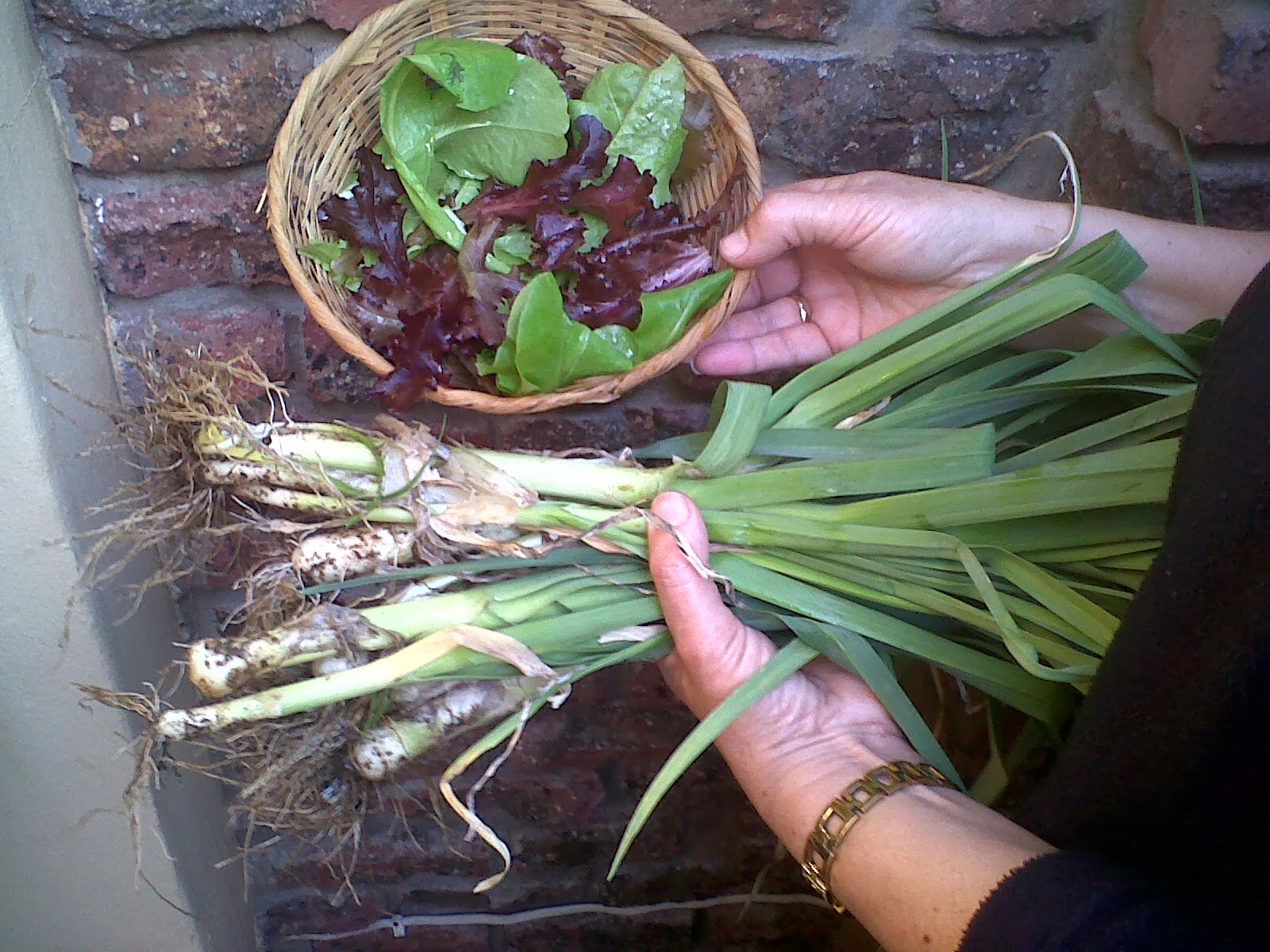
Start of Nov 2013 - Lots of leeks and lettuce/Pragtige preie en baie blaarslaai
In addition to the parsley, leeks and lettuce were the other two members of the trio of top performers. Lovely green and purple lettuce bought at Norgarivier Nursery and planted in the beginning of October went into beautiful green salads. The leeks went into a gorgeous Leek, Bacon and Cheese Pie. The family couldn't get enough! Basically you pre-fry the leeks in butter, add it and grated cheddar, a carton of cream, a packet of half-cooked bacon and two eggs to a pie tin, in pastry, and voila! If you don't have enough leeks (like I did), sommer add a few normal diced onions to taste. Works like a charm.

Mid-Nov 2013 - Pole and bush bean harvest/Rank-en bosboon oes
Beans always perform well in our backyard garden, so I expected nothing less this year. This year I planted white pole beans, Contender bush beans and Lazy Housewife pole beans. In the photo, the larger, flattish beans on the left are the Lazy's and the thinner ones are the others. I got the organic Lazy's at Livingseeds - a highly recommended organic seed store. The white beans and Contenders I got from another kindly neighbour. 

We have already enjoyed all of them as green beans and some of them have been blanched and frozen. Now I can't wait for the bushes to perform even better, so the granny can make a decent batch of curried beans yummy!


I planted twelve red onion seedlings during the last week of May, and about the same number of Australian Browns the first week of June. The red onions performed quite well, but the white onions produced the smallest onions imaginable. We harvested them all the very end of November.
The lesson I learned from this comparison? Do not plant onions in hard-as-nails and compacted soil!

Hope I haven't bored you all with this lengthy post, but I guess someone out there might pick up a tip or two from my successes and failures. What do they say; practice makes perfect.