Showing posts with label manure. Show all posts

22 October 2014

Warm Season Garden Planning. Warm Weer Tuin Beplanning

Welcome to my second instalment of fruit and veg garden planning. The last time I blogged about garden planning it was the beginning of our southern autumn and I was very hopeful and excited about the possibilities of my cold season garden. This time around I'm blogging midway through the spring, so therefore this post is about planning for warm planting season.

The success of my winter garden was a mixed bag of welcome delights and bitter disappointments. I can quite happily state though, that the failures in my winter garden was less to do with inadequate planning and more to do with being over-enthusiastic. Yes, once again I made some mistakes in my garden, but I will post on this in future. This post is about informing you on my plans for my three main fruit and veg beds, and the subsequent exertion put into getting ready for the summer season.


Backyard veg patch worked over and ready for compost/Agterplaas groentetuin is omgespit en gereed vir kompos


Calculating how much space you have

This season I spent the least amount of time on this step. You see; I have a mild case of OCD so I spent hours upon hours of measuring, re-measuring, calculating and re-calculating the size of all my beds in March of this year. This time around I just pulled up my Excel spreadsheet... and Bob's your uncle! I will admit that it took some minor fiddling here and there as my calculations were a bit off last time. As I am ever the perfectionist, this minor error had to be fixed. Just Had to!

The total size of my three main beds is 12.84m2 of which 7.72m2 is usable for fruit and veg production. This is due to certain areas being in the deep shade during certain periods of the day, or simply by perennials taking up the space. I know my space is severely limited, but one has to work with what one has, hey?


Deciding on which veggies or varieties to grow

Which summer fruit and veggies do we like to eat most?

If I go according to that list, my planning measures up in the following way: 
I already have a Granny Smith apple in my fruit bed. It's been in my garden about a year and a half and still going strong, but won't bear fruit for a while yet. I already bought my baby marrow (courgette/zucchini) seed at our local Agri store, but won't do butternuts again as they take up too much space. I also already have my dry beans, ready to be sowed. They're leftovers from last year's planting season. I don't have enough space for either cucumbers or grapes, so will still have to source those from our fantastic local fresh produce store, but the peppers were left in my garden. I treat them as perennials since they die back almost completely in the cold season, but always come back into their own late September. I saved three of the sweet potatoes I harvested from the garden in April to make new slips with. Currently the slips are beautiful, and forming roots in a little plastic tub filled with rain water. Tomatoes? I purchased twelve Moneymaker seedlings and cherry tomato plants from local nurseries. 
Sweet potato slips/Patatranke
Which fruit and vegetables worked in my garden last spring/summer?

Which plants or vegetables benefit most from each other?
Companion planting is a subject every organic backyard farmer must familiarise him/herself with. This is due to the fact that bugs and pests love fresh veggies just as much as we do, especially in a humid climate like the Garden Route's. I won't spray any (non-organic) pesticides, so the fruit and veggies are even more of a temptation to the little critters. The best way to solve, or at least minimise, this problem is to inter-plant fruit and veggies with beneficial herbs and plants and also plant trap crops like nasturtiums. The former assist and provide nutrition to the fruit and vegetables and the latter draw the pests away from our treasured produce. The idea behind companion planting is to create a small and balanced eco-system in your garden, thereby not providing fodder for bugs by planting a ton of the same plant or species. The best South African advice on companion planting is to be found on Livingseeds' website and another good table can be found here.

Which plants are most suited to my soil type and amount of shade?
This is a question that can only be answered with a great degree of certainty after the third or fourth growing season. Yes, as a gardener you will probably know what kind of soil you're blessed (or cursed with), and therefore which fruit and veggies are best suited to your property, but even this knowledge might be misleading. My blessing is the fact that my parents frequently composted in years gone by. My curse is that our natural soil is rich in clay, but luckily the same parentals sorted most of this out by extensively applying lime. I have never actually done a pH test on my soil so I can't say without doubt whether I have acid or loamy soil, but my bet is on good garden soil (somewhere between the two), as it is rich and black in colour (minus the small bits of clay left in some spots underground).

Drawing up a garden plan

I once again used the fantastic GrowVeg Garden Planner tool to assist in this task. This time around I decided to purchase a year-long membership. This enables me to not only draw up multiple garden plans without deleting and re-doing them one by one, but the tool also remember what I planted in a specific space before. This will help me with the next season's planning and planting, as the tool will give me crop rotation warnings etc. Brilliant hey! 

I've decided to share my Backyard Veg Patch plan with my avid blog readers again, if only to show you how the tool assists in the whole process... and how I've improved in utilising it haha. One thing I realised is that you can select the variety as well as the plant type. Practice makes perfect. Without further ado - here is my plan:
Backyard veg patch plan/Agterplaas tuin plan (copyright www.growveg.com)
At least I can say with all honesty that this phase of my planning took a fraction of the time this season. Thank you GrowVeg!

Preparing the soil

As I like to believe I learn from my mistakes, I decided to delay my summer season planting with a month or so this time year. My region experience most rainfall in Oct/Nov and Mar/Apr, although we do get rain most months of the year. Last year the combination of granny's impatience and my eagerness led us to sow and plant most of our warm season crops late August already. Mistake! Not only did some seeds drown in the heavy October rains, but the tomatoes and beans were more susceptible to blight, as the plants which did make it had to struggle through the whole wet season.

This time I only started to prepare my beds early October, and plan to plant my beans, courgettes, sweet potatoes and tomatoes late October. I can almost hear some readers gasp in horror. Surely one cannot sow tomatoes as late as that?! No dear readers, I've also learned from my second mistake - plant seedlings wherever possible and stay away from seeds. I learned this lesson by comparing my tomato production (dismal) to my best friend's 100m away in the same neighbourhood (bountiful). Yes, sometimes one can learn by observation of others.

As stated in my previous post, the MOST IMPORTANT TASK IN GARDEN PLANNING is soil preparation. I'm using upper-case again to emphasise just how important this step is. The two golden rules I've stayed with this year is composting and fertilising.

Unsatisfactory compost mixed with organic manure/Middelmatige kompos gemeng met organiese hoendermis
At the risk of becoming repetitive, the rule of thumb with composting is to add around 2 bags of good, organic compost to every square meter (roughly the equivalent of 2 inches of compost as a top layer). As I wasn't a hundred percent happy with the quality of the compost I purchased for most of my garden (it didn't have the healthy slight farm stink to it and was also too fine for my liking), I decided to add roughly one part pure organic chicken manure to two parts (unsatisfactory) compost. Problem solved. Unfortunately the organic chicken farm where I usually purchase my manure ran out. After briefly wondering how a chicken farm runs out of chicken poo I decided to stock up at the other organic chicken farm in the vicinity. Tip to future buyers from said farm: ask for chicken compost, as the cashier doesn't know it by any other name... and I mean any other. Luckily I also bought four big bags of great, organic compost for my backyard veg patch elsewhere, so those didn't need added manure.
The good stuff - Grow Green Organics compost/Swart goud - Grow Green Organics kompos
A rule of thumb with fertilising is to add about 150g composted chicken manure to every square meter - around fruit trees especially. 50g equals about a handful. A good organic option is either Bounce Back (around R60.00 for a 5kg bag). A cheaper option is Rescue, which is also pelletised chicken manure, but comes in a less snazzy bag. I opted for the latter and bought 4kg for only R40.00 (a 17% saving) at Norgarivier Nusery on the Old Airport Road.

I did most of the composting about a week ago, and did the fruit tree fertilising a few days ago. Now I just have to wait the required two weeks after composting to get in my selected vegetables for the summer season. What did I choose to plant this time around?
  1. Contender bush beans (seed): as they produce quicker than pole beans and don't cast shade on other plants in my very limited gardening space.
  2. Caserta courgettes/baby marrows (seed): as they require a fraction of the space gobbled up by butternuts or other pumpkin varieties
  3. Cucamelons (seed): as they are simply too adorable to resist
  4. Sweet potatoes (slips): after the success of last year I would be crazy not to plant it again!
  5. Cherry tomatoes (seedling): as they grow and produce quickly and are more hardy to diseases than big tomatoes.
  6. Normal sized Moneymaker tomatoes (seedling): the name convinced me ;-)
And that is my summer season garden planning story... in detail... maybe too much detail

(... but who cares...)

4 June 2014

Looking back on my Autumn Garden. Terugblik op my Herfstuin

It's now the fourth day of winter here in the southern hemisphere. The weather only changed dramatically today, unleashing cold and wet conditions over the Garden Route. Therefore, I thought it an opportune time to look back on the goings on of my backyard veg patch in the last month of autumn.

The Witkiem broad beans sowed middle April are going strong; reaching for the sky they are. The Carentan leeks look beautiful. I'm very chuffed with them. The Sugar Ann Snap Peas are also doing well, but a little bit less so than the broad beans. I'm worried that they're still so small and straggly, but the granny assures me this is normal. It's "bush" peas after all. Let me show you what I mean:
Carentan leeks left and Witkiem broadbeans to the right/Preie links en boerbone regs
Sugar Ann snap peas in the bottom left hand corner/Erte links onder
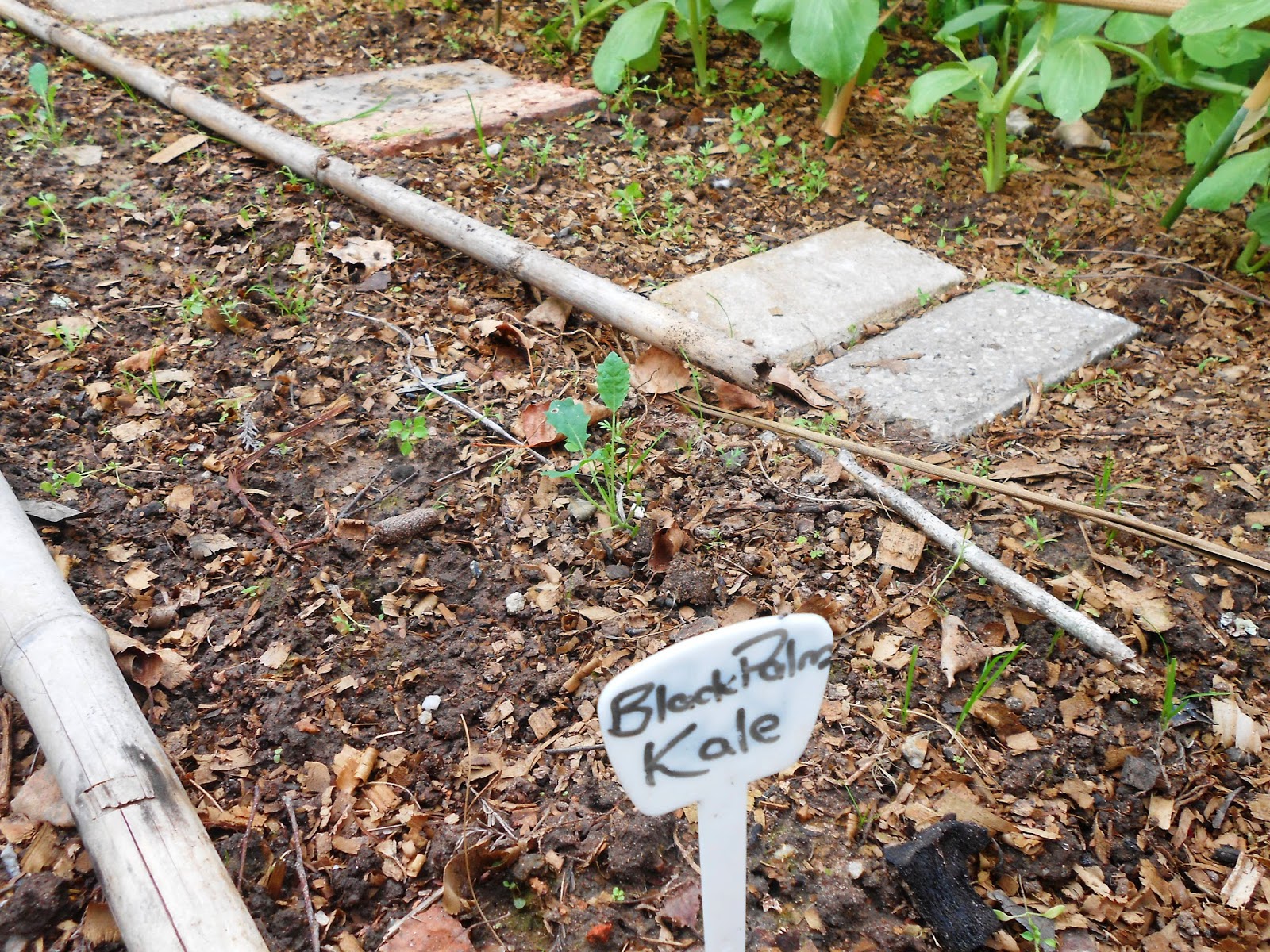
Something that's not doing as well is the kale. I sowed the Black Palm kale just a day later than the peas and broad beans, and yet they are barely 5cm tall. I don't know if it's due to the general scarcity of sun in their neck of the woods in the cooler season or something else. Maybe snails? I'm hoping against hope that the kale is just a slower grower than the broad beans or peas. Some of the latter are situated in parts of the veg patch just as plagued by shadows as the kale. Oh well, at this moment I can just hold thumbs I guess. Does anyone have any idea what I could do to aid the kale's growth? Or is this quite normal for cold-season kale growth?
A teeny tiny kale plant/Eina-klein boerkool plantjie
The tamarillo is doing splendidly, as per usual. The bergwind once again tried it's best to destroy the tree tomato, but it's still standing. Askew, but still alive. The angle with which the tree is growing is actually aiding fruit development, or so I read. This is because the tamarillo makes side branches when at an angle, and these side branches also produce fruit. My tree is full of big, beautiful tree tomatoes. I'm thinking a Foreign Friday entry would be appropriate once I actually harvest some of them. Just look how gorgeous they are:
Tamarillo fruit/Tree tomatoes/Boomtamaties
Another vegetable which didn't do particularly well this time around were radishes. This was a bit surprising as I've found radishes to be so easy before. Well, not anymore! This time almost all of them had long, leggy red roots instead of orbs of peppery goodness. I didn't sow them that long after I worked chicken manure into the garden, so I think the soil might have been too fertile, or the manure still too strong. That, or it was simply not sunny enough. I did manage to harvest one meagre hand full though. It went straight into my Sweet Potato Winter Soup. I will share the recipe at a later stage.
A handful of radishes/Handjievol radyse
Some inroads were made into solving the shade problem. Well, maybe solve is a bit of an exaggeration. I chopped down another cordyline in order for the morning sun to touch my garden a few minutes more. I tried to saw through the tree trunk, but it was not to be. In the end I had to chop it down. I felt like a veritable Huntsman as the wood chips went flying and the axe went deeper into the tree. It took ages, but I conquered! 
Halfway there with the cordyline
Doing it the green way... sweat and aching muscles followed
A while ago I also sowed coriander and Little Gem lettuce in my biggest container. The lettuces don't look as promising as I would want, but the coriander is going strength to strength. We don't really eat coriander leaves, or what the Americans call cilantro, in my home. The taste is way too "volksvreemd" for us, but I sowed it for the seeds. It gives such a great taste to meat and our national favourites; droëwors and biltong (pickled dried meat similar to beef jerky).
Coriander popping its head out/Koljander plantjies pop orals uit

My Cape gooseberry bushes fill me with joy at the moment. I haven't had any success in the year I've had it. Admittedly the wind destroyed my first bush. Just as it recovered, the sun scorched it almost to nothingness. I subsequently moved the container, and it looks happier now. Happier and producing a husked berry here and there. The real success is the volunteer Cape gooseberry which turned into a giant, almost untameable, bush in the backyard veg patch. I've tried to minimise its encroachment into my vegetable area without removing the bush. So glad I didn't take it out; it is Covered in berries! I have dreams of making Appelliefie Konfyt (Cape gooseberry jam), or just munching on the little golden beauties. Can't wait! 
Little Cape gooseberries galore/Appelliefies in oorvloed

12 March 2014

Autumn Backyard Garden. Herfs Agterplaas Tuin

My garden is in its transitional phase at the moment. Some summer vegetables are still producing, some are barely clinging on, most are dead, and I am itching to start planting autumn and winter veggies. 

Preparation is key to planting in any season, so I started by working over the bed where my butternuts were, and added some beautiful black gold. Yes, I did go for that turn of phrase because the alliteration has such a nice ring to it... Okay; the 'black gold' I'm referring to in this instance is chicken manure (chicken poo). I bought it at one of the only truly organic chicken farms in the Garden Route area; Red Barn. Go and check it out for yourselves people. The owner doesn't use any nasty antibiotics or chemicals and her chickens are free range in every sense of the word. The bed is nearly ready for the onions I will be planting there in April. I must still just pull out the miserable tomatillos and add some sand. This is how the bed looks now:
Chicken manure added to Onion Bed/Hoendermis by Uiebedding ingespit
 ... and this is why I said "miserable tomatillos":
My one and only tomatillo/Die som van my tomatillo oes
I can proudly say not everything is a miserable failure at the moment. Some plants actually still produce, even if the harvests are mostly meager. The star in my little Garden Route patch is still the pepino, as ever. I have also harvested volunteer cherry tomatoes constantly, but I can't take much credit for these. They are virtually indestructible! We are also enjoying the occasional bunch of Contender beans. The granny picked another 300g the day before yesterday, and we just had it in a gorgeous sweet curry with potatoes, cabbage, carrots, and meat yum :-)
Harvest:  450g pepino + 150g cherry tomatoes + 2x cucamelons
Let me take you on a quick tour of the rest of my garden...

The Delicious Monster starting to fruit/Vrugte aan die Monstera deliciosa
Our Delicious Monster (Monstera deliciosa) plant is clearly not past its fruit-bearing age, as I previously thought. I cannot wait for these babies to open up and ripen!

Cherry Guava covered in fruit/Klomp klein vruggies aan die Aarbeikoejawel
The little Cherry Guava/Strawberry Guava (Psidium cattleianum) tree is such a star. It has loads of little guavas, just 6 months after it last bore fruit.
 
Two hiding cucamelons/Die Mexikaanse Suurkomkommertjies kruip goed weg
I might have done exactly all the Wrong things as far as the cucamelons (Melothria scabra) go this year, but luckily I spotted a few small ones hiding behind dense leaf coverage. Yes, I will try them again later this year, and this time I will do it right!
 
Bell Peppers/Die klokvormige soetrissies begin dra
I have a suspicion these bell peppers might already be a strange hybridisation, as the granny used to grow all types of capsicums in close proximity. My motto: who cares, as long as they taste nice, hey?
 
Tamarillo flowers/Boomtamatie blommetjies
Since I bought my Tree Tomato (or tamarillo as Kiwi's call them) in May 2013 it has literally reached for the sky. The tree is now taller than my 6ft1, the leaves are humongous and yet I haven't picked one single fruit from it. Is this normal? I wouldn't know, but my granny certainly had a mouthful to say about it. I'm sure the words "pull out" have entered her mind. Luckily disaster seems to be averted, as I have spied some petite flowers up top. Is this a sign of juicy tamarillos to follow?
 
Another Black Hungarian Pepper/Nog 'n Swart Hongaarse Soetrissie aan't vorm
This will be the second little Black Hungarian Pepper to be harvested. It might have been more if I didn't accidentally destroy most of the plants. An honest mistake due to it looking suspiciously like yet More purple tomatillos... whoops!
 
Yet another ripe pepino/Nóg 'n boomspanspek is gereed om te pluk
Not much more to say about this one. Yes, the pepino is officially the gift that keeps on giving :-)
 

4 March 2014

Cold Season Garden Planning. Koue Weer Tuin Beplanning

I started avidly growing veggies in my backyard about 9 months ago, in the depths of 2013's winter. I was so eager to start, that I totally ignored the time of year and therefore got miserable results. Results which should have been expected, but nevertheless disappointing beyond belief. Yes, most new gardens are over-eager and make the fatal mistake of focusing on the vegetables/fruit trees/plants, instead of the soil. All the research I did beforehand warned me of this fact, so I had no excuse.

I won't make the same mistakes again, or I will at least try to improve on what I did wrong last year. Planning is one thing I'm very good at; sometimes so good that I plan and plan and plan, but never really implement. A character flaw I know. This is how the planning for my autumn and winter garden is coming along so far:

Calculating how much space you have

This was the logical first step for me, since the available space (and the type of space) will tell you the type and quantity of vegetables to plant. No simple task for me, as most of my space isn't square or rectangular beds, but have weirdly winding or circular edges. Blame my parents for their creative garden planning! For any other person this wouldn't be such a hassle, but I'm a sucker for precise calculations and mathematical formulae. Yes, I'm not only a garden geek, but a geek geek as well haha. After countless tries with a broken tape measure, pen and paper, and even calling in the help of a genial best friend (those damn formulae!) I had calculated my veg garden size to near precise dimensions. And so the real fun began...
 
Backyard Veg Patch - cold season crops to follow/Lappie vir herfs en winter groente

Deciding on which veggies or varieties to grow

The four factors which influence me on what to grow and where to plant it, are;
  • What do I like to eat? More specifically, what does my family like to eat?
  • What worked in my (or the granny's) garden before?
  • Which plants or vegetables benefit most from each other? (Companion Planting)
  • Which plants or vegetables are most suited to my soil type and amount of shade?

Drawing up a Garden Plan

This is one step that small-scale backyard gardeners don't have to spend too much time on. Being the kind of person that I am, I've spent hours and hours planning, calculating, drawing and re-drawing my very first Garden Plan(s).

I only have three spaces suitable to vegetables and the occasional fruit tree; they measure:
  • 6.1 sq meter (of which 4.8 sq meter can be used due to perennials)
  • 7.8 sq meter (of which 1.4 sq meter can be used due to shade and trees), and
  • 1.52 sq meter (all suitable for planting)
This leaves me with only about 15.5 sq meter. Not much by any stretch of the imagination, so therefore pre-planning is vital to optimise my space.

The most wonderful tool I've discovered online is the GrowVeg Garden Planner. Not only is it free for a 30-day period, but all features are available to users of the free trial programme! The first step in the design is to tell the programme the length and width of your bed. Then you simply choose a veg/fruit/flower type and plan out the rows or blocks desired. The nifty little programme will tell you automatically how many of said plant you can chuck into said space. Marvelous!

Here is an example of my backyard vegetable patch:
Backyard Veg Patch Plan/Agterplaas Tuinplan [copyright www.growveg.com]
See the full plan, all suggestions, and how wonderful this site really is at GrowVeg.com

Preparing the soil

As soon as the summer veggies and flowers start looking a bit straggly and production comes to a grinding halt, it is time to pull them out and either compost or destroy them, depending on whether they are still healthy specimens. This normally happens the last month of summer or in early autumn. In areas where chilly weather comes sooner (like the Free State or Gauteng) it would most probably be end Feb, and the Garden Route area where I live it's more likely to be March. There is no hard and fast rule to the month of the year though. 

From Pumpkin Patch to Onion Bed/Toekomstige wit-ui tuiste?
Now comes THE MOST IMPORTANT TASK IN GARDEN PLANNING... Soil preparation. It is very important to spend most of your available finances on preparing the soil well and the smallest amount on buying plants or seed. The type of soil you have is also very important. This is because you will need to add coarse sand to hard, clay soil or huge amounts of compost to loose, sandy soil. I have a mix of good garden soil and heavy, clay soil in my own garden.  

A rule of thumb is to add two bags of good, organic compost to a square meter of your garden. That is roughly equivalent to 2'' of compost (5cm) on top of your bed. It is also a good idea to add a complete fertiliser to your garden. 10-10-10 fertiliser is the best one to go with (equal amounts of nitrogen, phosphate and potassium). Manure is an alternative to compost, but must be well-rotted. A good indication on whether it is suitable for your veg patch is to smell it. If it doesn't reek to high heaven, it apparently is black gold!
A scattering of red onions to follow/'n Paar rooi uie midde-in die vrugte bedding?
All the preparation stuff must be done at least two weeks before any planting. I've just realised it's already March, and I haven't done even a square foot of soil preparation. I will definitely have to order a bakkie-load of compost from Norgarivier Nursery, some fertiliser... and get in my garden, sweating away!