Showing posts with label nasturtiums. Show all posts

30 September 2014

Spring Has Sprung. Dis Heerlike Lente

I do not want to dedicate this post to anything particularly enlightening, other than to say... SPRING HAS SPRUNG :-) Dis heerlike lente, die winter's verby.... and with spring a multitude of flowers are in bloom. Most of the colour in my garden comes from the indigenous clivias I blogged about way back in October 2013. 

I'm not going to ramble on and on about how delightful the flowers in my garden are. No, let the photos rather speak for themselves in this case:
Orange and red clivias/Oranje en rooi clivias
Sole clivia hiding in the ferns/Clivia wat wegkruipertjie speel in die varings
Yesterday Today and Tomorrow and a Bird of Paradise/Strelitzia
Clivia lane/Laning gevestigde clivias
Bright red clivia seeking sun/Bloedrooi clivia steek kop uit
White Arum lily behind multi-coloured nasturtiums/Aaronskelk agter die kappertjie bos
Sadly I don't know which type of orchid this is... my Ma noem dit sommer 'n Armmasorgidee
Lavender flowers and yellow clivia/Laventelblomme en geel clivia in die agtergrond

2 December 2013

Spring Harvests. Lente Oeste

With it already being the second day of summer here in South Africa, I thought it appropriate to report back on what I harvested in my backyard garden (and also in other patches scattered throughout) during spring. While some vegetables performed quite well, others were simply not suited to our Garden Route climate, or suffered because of my inexperience and a lack of sunshine. This is what I harvested:
 
End Sep 2013 - nasturtiums, strawberries and "cauliflower"/kappertjies, aarbeie en "blomkool"
The first plants to produce anything vaguely fit for "harvest" were nasturtiums I sowed late July in a container and strawberries the granny and I planted late May and late June. Nasturtiums are always rampant growers, so I didn't expect anything less of them. On the other hand; I am currently planning to replant my strawberries in the soil, because they're not producing as they should in their pots, but then again; maybe their pots are too small. Questions, questions... I won't even mention the cauliflower, as they were a total failure. Of the twelve plants I purchased and planted late May, I didn't get one decent-sized cauliflower head. The biggest one was about 2cm x 2xm! I think I planted it too late in the year, because they got some sort of fungal disease. Perhaps I should plant them earlier in autumn next time?

Start of Oct 2013 - Some of the radishes/Sommige van die radyse
Radish was the one vegetable that performed brilliantly in the garden. Such a quick perfomer as well! I sowed them mid-August and harvested these beautiful babies in the beginning of October. How chuffed was I! The one thing I learned for myself is that they perform miserably in shady areas. Radishes I planted between my broad beans, in a mostly shady area, could only be harvested two weeks later than the ones in full sun, and were stunted and small. Yes, all sources told me most vegetables don't work well in shade, but I had to see it for myself, okay. Haha

Mid-Oct 2013 - An abundance of parsley/Pietersielie vir Afrika
Parsley, parsley and more parsley! Yes, parsley was definitely the biggest star in my spring garden (and I have the dried bottles of parsley to prove it). Both the curly-leaf and Italian varieties performed well, although the latter out-shined the former to an extent. Now that it is summer I'm having problems with them going to seed, but that is to be expected I suppose.

End Oct 2013 - Meager broad bean haul/Skamele boerboon oes
Yes, I made the same mistake with the broad beans as with some of the radishes... too much shade! What started out as a beautiful bed of beans under a leafless Acer negundu tree in autumn, turned out to be the aphid-infested bane of my existence under a fully-leaved Acer in spring! Regrets, regrets! Especially because the little broad beans I could harvest tasted so heavenly in one of the mother's Cape Malay curries. Ai! Note to self - plant broad beans beginning of autumn in a sunshiny spot next year!

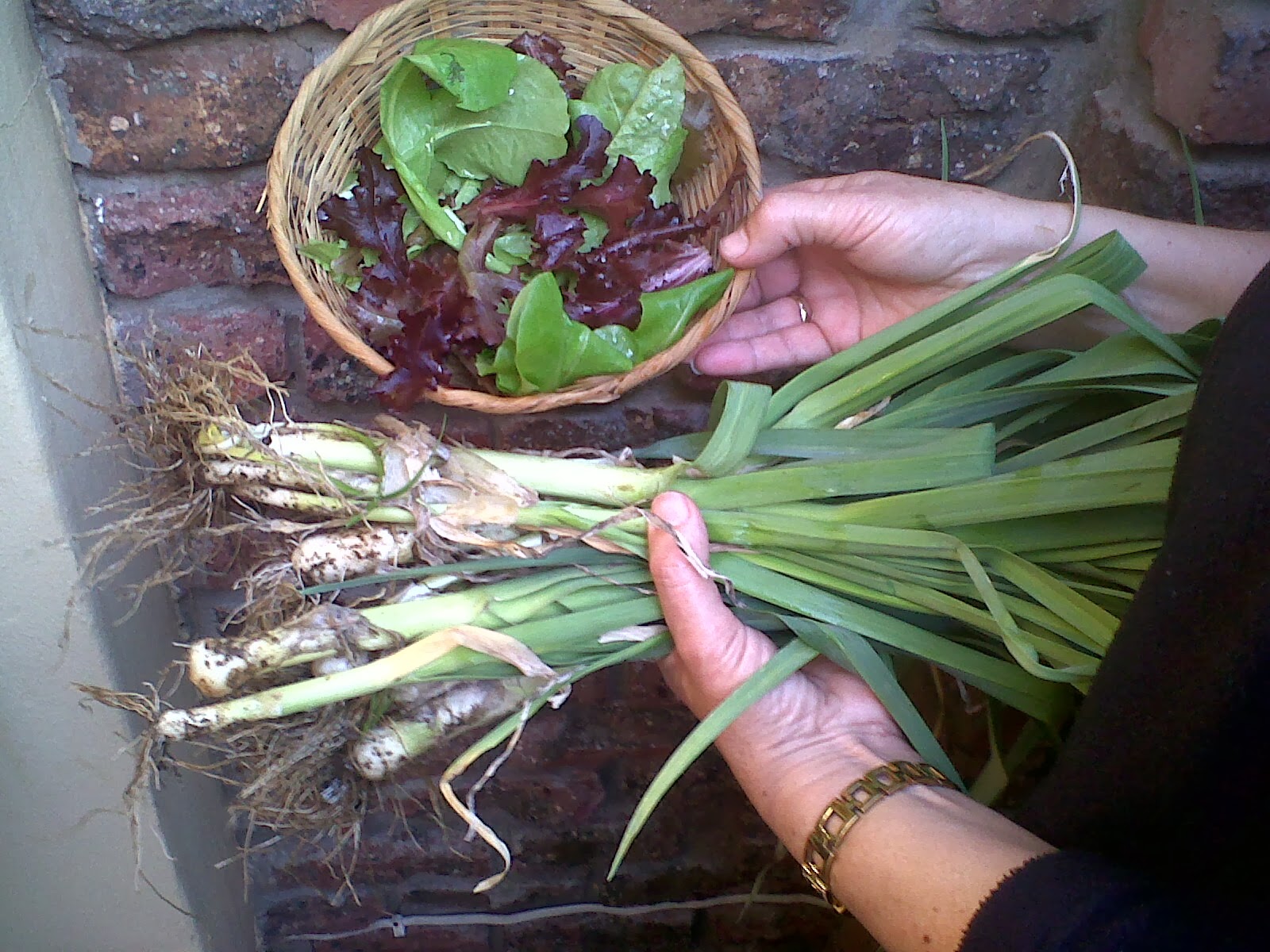
Start of Nov 2013 - Lots of leeks and lettuce/Pragtige preie en baie blaarslaai
In addition to the parsley, leeks and lettuce were the other two members of the trio of top performers. Lovely green and purple lettuce bought at Norgarivier Nursery and planted in the beginning of October went into beautiful green salads. The leeks went into a gorgeous Leek, Bacon and Cheese Pie. The family couldn't get enough! Basically you pre-fry the leeks in butter, add it and grated cheddar, a carton of cream, a packet of half-cooked bacon and two eggs to a pie tin, in pastry, and voila! If you don't have enough leeks (like I did), sommer add a few normal diced onions to taste. Works like a charm.

Mid-Nov 2013 - Pole and bush bean harvest/Rank-en bosboon oes
Beans always perform well in our backyard garden, so I expected nothing less this year. This year I planted white pole beans, Contender bush beans and Lazy Housewife pole beans. In the photo, the larger, flattish beans on the left are the Lazy's and the thinner ones are the others. I got the organic Lazy's at Livingseeds - a highly recommended organic seed store. The white beans and Contenders I got from another kindly neighbour. 

We have already enjoyed all of them as green beans and some of them have been blanched and frozen. Now I can't wait for the bushes to perform even better, so the granny can make a decent batch of curried beans yummy!


I planted twelve red onion seedlings during the last week of May, and about the same number of Australian Browns the first week of June. The red onions performed quite well, but the white onions produced the smallest onions imaginable. We harvested them all the very end of November.
The lesson I learned from this comparison? Do not plant onions in hard-as-nails and compacted soil!

Hope I haven't bored you all with this lengthy post, but I guess someone out there might pick up a tip or two from my successes and failures. What do they say; practice makes perfect.

1 November 2013

Foreign Friday. Volksvreemde Vrydag

Strawberry or Cherry Guava/Aarbeikoejawel (Psidium cattleianum)


One of my most vivid childhood memories is of the Cherry Guava tree we had in the backyard. I can remember the sweetly tart strawberry-like taste, the amount the brother and I used to gobble down, and the smell of overripe guavas in the hot South African sun. Unfortunately the tree had to make room for extensions to the house, but the memory is still clear.

When I couldn't seem to find a Chilean Guava anywhere in the country, it was therefore not a giant leap for me to settle on the Cherry Guava as stand-in. I blame James Wong for publishing such a delicious-looking guava and quince Rumtopf recipe on his site, made with the fruit of an impossibly difficult plant to source! 

The folks across the water tend to call our Cherry Guava either a Strawberry Guava or a Cattley Guava, but I'll stick to my Proudly South African roots. The tree grows easily in just about any soil, although some organic material and free-draining soil is a must. It grows into an average sized shrub to small tree, depending of the area you live in and the climatic conditions there. Here, in the Garden Route, they tend to grow to between 2m and 3m tall. The tree fruits heavily, and the fruit itself is very nutritious and low in calories. It contains around 60Kcal per 100g.

As I blogged about before, I decided to plant my Cherry Guava in the front-yard garden. I was quite fortunate to get a tree which already had a few fruit on it from my preferred local nursery. Before you pop one of these little treats in your mouth, just heed my warning about fruit-fly bites. The fruit might look normal from outside, but inside it could well be infested with worms. Unfortunately flies and birds like the little deep-red guavas just as much as we do...
My very first Cherry Guava/My heel eerste Aarbeikoejaweltjie
So in went my little tree, and I couldn't be more happy with the result. It took off like a duck to water.
The granny watering newly planted Psidium cattleianum
Since I knew about, and experienced first-hand, the fly problem with the Cherry Guava, I decided to give companion planting a go. At least, I planted a trap crop of nasturtiums and hoped for the best. Dalk was die kappertjies nie die beste keuse nie? The fact that the trap crop I chose normally traps aphids didn't put me off at that stage. I just wanted some nasturtiums damn it! I will definitely add some chives and the like later to repel the pesky fruit-flies though.
Nasturtium seedling/Kappertjie plantjie
Companion planting at its best??? Aarbeikoejawel + Kappertjie???
Oh, how I can taste Cherry Guava Cordial and Guava Crumble already! The following recipe especially appealed to me when I walked across it on another local blog -

Cherry Guava Apple Crumble:

  • Make Cherry Guava pulp by boiling a colander full of guavas, a cup of water and two tablespoons of sugar for 20mins, strain. The mass should be a thick pulp.
  • Crumble:
    • 300g plain flour
    • 175g sugar
    • 200g soft butter
  •  Filling:
    • 450g peeled, cored and sliced apples (tinned apples make a fine substitute)
    • 1tb sugar
    • 1tb plain flour
    • pinch of cinnamon
  • Method:
    • Preheat oven to 180 degrees Celsius
    • Make the crumble by adding the flour and sugar together and rubbing the butter in
    • Add all the filling ingredients to a large bowl and stir well
    • Grease a 24cm dish and spoon the filling in, then pour Cherry Guava pulp over
    • Sprinkle the crumble on top
    • Bake for 40-45mins

Will you be planting a Cherry Guava in your urban garden?


Botanical Name: PSIDIUM CATTLEIANUM
Common Name: Cherry Guava, Strawberry Guava, Cattley Guava
Volksnaam: Aarbeikoejawel
Native to: Brazil (tropical Amazonian regions)
Date planted/sowed: Planted late June 2013 (winter)
Ease to grow: Very easy to grow
Costs: R45.00 for a small tree
Notes: Tree fruits quickly, but need to guard against fruit-flies and birds

21 October 2013

South African Container Gardening. Kleinskaalse tuinmaak in die Tuinroete

The one problem all backyard farmers and urban gardeners share is surely the lack of space. While I would love to plant an orchard of apple trees, another of various peaches, a few exotics like loquats and avocados, space; or the lack thereof, simply makes this impossible. Oh, and the mother, who is filled with dread at any mention of planting a new tree! Not only do I face space problems as far as fruit trees go, but also for smaller shrubs and even vegetables. My backyard is tiny, so there's only so much lawn I can take out, and most of the front yard is outside the boundary wall. I can't plant vegetables there, because I want to actually harvest some for myself...

What to do?

The answer most obviously lies in container gardening. Filling every container I already own, and getting new ones made by the father. Sulke pragtige hout bakke; hoe trots is ek!

The first thing I planted in a container was a Cape gooseberry I received as a gift from a colleague. I added two smaller ones in the same plastic container. So far so good. It's just that the area I had it in earlier was too windy in winter and too sunny in summer. Note to self; choose a sheltered spot for Cape gooseberries.

Cape Gooseberries in plastic container/Appelliefies in plastiese houer
The next thing to go into a container were herbs. My family isn't big into "volksvreemde kruie" (strange herbs) so I went for curly and flat-leaf parsley. The same container got a pest-repellant marigold in and a strawberry plant or two. I was quite chuffed with the arrangement, although the parsley grew so rampantly, it kind of overshadowed the strawberries:
Parsley and Strawberry container plus Nasturtiums


Kappertjie bak en Pietersielie plus Aarbei bak in agtergrond


Next I had to beg and plead and go down on my knees for quite a few weeks with the father. You see, he promised me a few wooden containers, but none was forthcoming. After a little bit more irritating pleading I got my way... and three amazing containers! In the first one I sowed cucamelons, as recommended by James Wong. I also sowed chives, but have had no success with them so far. The cucamelons only took  3 weeks to germinate, and the germination rate was quite good as well. Maybe I don't have the right technique for chives yet? I decided on yarrow as the companion plant to repel pests. Two out of the three has come on beautifully:
Yarrow and cucamelons at back/Duisendblad plante en Mexikaanse Suurkomkommertjies
The smallest container would get a few more herbs I thought, but in the end I settled on a comfrey plant, garden mint and a small sowing of Pak Choi. The reasoning behind this combination was that garden mint would be quite useful in summer drinks, and pak choi is apparently a hardy lettuce-like Asian vegetable. It can grow in much warmer conditions than plain lettuce, without bolting or dying. Comfrey is a gardener's best friend, according to some blogs I've read, especially African Aussie. This is because it puts valuable nitrogen back into the soil. So I had to plant at least one:
Pak Choi sowed in front, garden mint left and comfrey right/Tuinment links en Smeerwortel regs
The medium-sized container was a toss-up. At first I wanted to plant some sweet potato slips there, but then I planted those in our front garden. The plan changed to lettuce and green peppers, but our backyard would be too hot and sunny in summer for the former, so I settled on potatoes. Originally I wanted to plant my potatoes in tyre staggers, but after reading horrifying stories about heavy metals leeching into the soil, and therefore into my beautiful homegrown tatties, this plan was abandoned. Now I had to fit 6 potatoes in one smallish container. Lets hope it works:
The Potato Container/Die Aartappelbak
Last but not least was a flat, wooden container the granny and I revitalised. Although it gets mostly shade our thyme seems to do well in it, but since I also bought normal lettuce the green peppers that filled the rest of the container had to go. We also turned the container around, so the thyme would get most sun, and the lettuce very little. Out with the old, and in with the new. Hope this experiment pays of...
Thyme in the background and Lettuce to the front/Tiemie en Blaarslaai
I'm very keen on seeing whether this type of gardening produces good results. I guess it's a waiting game now...