13 August 2014

Backyard Harvest. Agterplaas Oes

Yes, I'm still here. The computer might've given in and the winter garden might be coming along very slowly, but I'm still here. Still interested in getting my hands in the dirt, growing some useful fruit and veggies and some random ones, and subsequently blogging about it. The massive delay in this post wasn't intentional, but sometimes technology really gets in the way rather than assisting, don't you think?

Since I'm a bit out of practice I will let the photos do most of the talking. Let me get on with it...
Cape gooseberries/appelliefies, strawberry/aarbei, pepino/boomspanspek, Sugar Ann peas/ertjies
How does that cute chocolate advert go? "I've got joy in my life..." Yes, joy, joy and more joy... my Cape gooseberry bush is producing enough for a daily snack and then some. I've even made a summery fruit salad by adding it to chopped pineapple, paw paw (papaya) and pepino. Yes, the tropical pepino bush is unbelievably producing smack-bang in the middle of winter. What did I say? Joy!

Strawberries are only starting to flower now, so I've eaten the odd one straight from the plants. I've harvested quite a few cute Sugar Ann Snap peas though. We prefer them fresh in a mixed green salad. If you have any ideas what else to do with them, let me know.

Sugar Ann Snap peas/ertjies and Little Gem lettuce/blaarslaai
After last year's disastrous attempt at growing lettuce, this year couldn't make me prouder. Just look at the scrumptious lettuce leaves in the photo above. I grew them in the proper season and in a well-composted container this time though. That might be the reason for my success this year. Maybe not "might" - more a definite. The peas are so deliciously crunchy and sweet, I will definitely plant them again next autumn. I think I will dedicate much more of the backyard veg patch to them though. The harvest wasn't nearly enough for the family. Practice makes perfect, hey?

Cape gooseberries/Appelliefies
Oh boy, I harvested 300g of Cape gooseberries (also known as Inca berries) in one go. From one bush! It was a proud moment. Silly, but proud. Did I mention this was a volunteer bush that just shot up in my backyard veg patch? The same one I gushed about in my June post on the autumn garden.

Broad beans/Boerbone
Although my broad beans aren't really ready yet, there were about ten of them waiting to be harvested. No, the wee offering in my hands isn't the sum of it, but I just had to take a photo. I've never really done anything with broad beans, so I went out on a limb and sautéed them in butter with leeks. It went quite nicely with our "boerekos" chicken, potatoes, carrots and peas. What do you guys do with broad beans? I need some ideas here, but I'm not too keen on tossing them with mint leaves as I've read online. In my house mint is something that belongs in a refreshing cooldrink like lemonade.

I promise to pop in again soon. Why don't you tell me what you've been up to in your winter garden in the meantime?

24 June 2014

Winter Soup. Wintersop

Since the winter solstice is just a few days behind us here in the southern hemisphere I thought a post on soup would be appropriate. A colleague and I always joke about the link between overcast/rainy weather and soup. Yes, the fare in my household is quite predictable. Soup would be a safe bet on a rainy winter's day. It is not the rule, but nevertheless a common occurrence. 

One of my favourite soups (both to eat and to make) is what I call Sweet Potato and Chicken Soup, or simply Winter Soup. It is hearty, delicious and packed with anti-oxidants. The last few sweet potatoes from my haul in April went into preparing the latest batch. Yes, the sweet potatoes I harvested between the conifers and fruit trees.

Let me share the recipe with you. It serves 6-8 people, depending on the size of the pot ;-)
 
Veggies, chopped up and ready to go into the pot/Groente, opgesny en gereed om pot toe te gaan

Winter Soup Recipe:

4x medium sweet potatoes/medium patats
4x pieces of chicken/hoender
1x large onion/groot ui
3x medium turnips/medium rape
6x leeks/preie
3x parsnips/parsnepe
8x carrots/wortels
bunch of parsley/bondeltjie pietersielie
chicken spice, salt and pepper/hoenderspeserye, sout en peper

Sauté onions and leeks lightly
Brown chicken and spices together
Add water to cover chicken and onion mix and bring to the boil
Roughly chop all vegetables and add to pot
Fill the pot with water and bring to boil
Turn heat down to simmer for 2-3 hours
Add parsley 15mins before serving

The recipe isn't an exact science, but your tastebuds should guide you. If the soup tastes bitter, add another sweet potato etc.
Winter Soup - ready to be served with fresh bread/Wintersop - gereed om met vars brood geniet te word

Which soup warms your heart in winter-time?


4 June 2014

Looking back on my Autumn Garden. Terugblik op my Herfstuin

It's now the fourth day of winter here in the southern hemisphere. The weather only changed dramatically today, unleashing cold and wet conditions over the Garden Route. Therefore, I thought it an opportune time to look back on the goings on of my backyard veg patch in the last month of autumn.

The Witkiem broad beans sowed middle April are going strong; reaching for the sky they are. The Carentan leeks look beautiful. I'm very chuffed with them. The Sugar Ann Snap Peas are also doing well, but a little bit less so than the broad beans. I'm worried that they're still so small and straggly, but the granny assures me this is normal. It's "bush" peas after all. Let me show you what I mean:
Carentan leeks left and Witkiem broadbeans to the right/Preie links en boerbone regs
Sugar Ann snap peas in the bottom left hand corner/Erte links onder
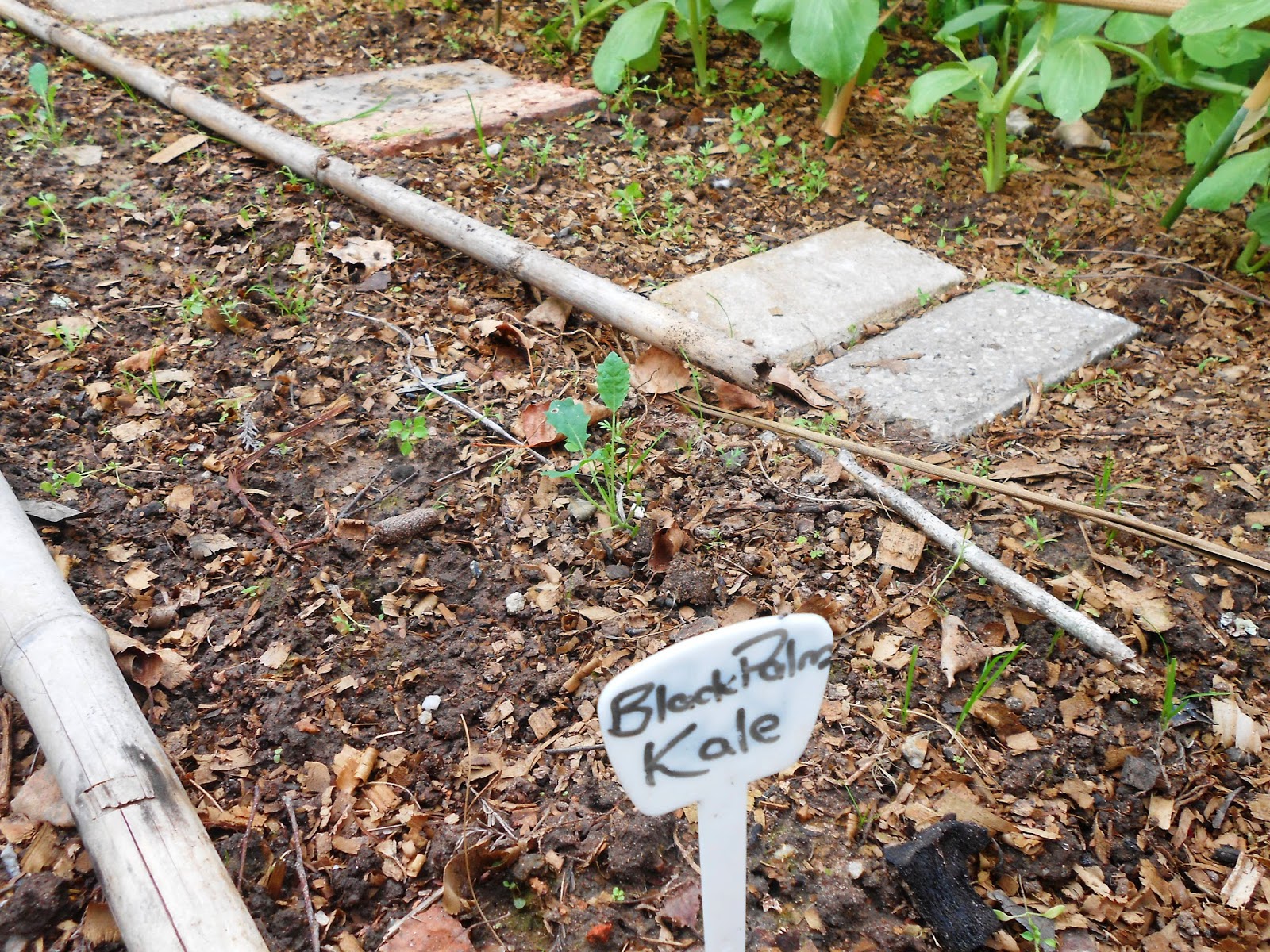
Something that's not doing as well is the kale. I sowed the Black Palm kale just a day later than the peas and broad beans, and yet they are barely 5cm tall. I don't know if it's due to the general scarcity of sun in their neck of the woods in the cooler season or something else. Maybe snails? I'm hoping against hope that the kale is just a slower grower than the broad beans or peas. Some of the latter are situated in parts of the veg patch just as plagued by shadows as the kale. Oh well, at this moment I can just hold thumbs I guess. Does anyone have any idea what I could do to aid the kale's growth? Or is this quite normal for cold-season kale growth?
A teeny tiny kale plant/Eina-klein boerkool plantjie
The tamarillo is doing splendidly, as per usual. The bergwind once again tried it's best to destroy the tree tomato, but it's still standing. Askew, but still alive. The angle with which the tree is growing is actually aiding fruit development, or so I read. This is because the tamarillo makes side branches when at an angle, and these side branches also produce fruit. My tree is full of big, beautiful tree tomatoes. I'm thinking a Foreign Friday entry would be appropriate once I actually harvest some of them. Just look how gorgeous they are:
Tamarillo fruit/Tree tomatoes/Boomtamaties
Another vegetable which didn't do particularly well this time around were radishes. This was a bit surprising as I've found radishes to be so easy before. Well, not anymore! This time almost all of them had long, leggy red roots instead of orbs of peppery goodness. I didn't sow them that long after I worked chicken manure into the garden, so I think the soil might have been too fertile, or the manure still too strong. That, or it was simply not sunny enough. I did manage to harvest one meagre hand full though. It went straight into my Sweet Potato Winter Soup. I will share the recipe at a later stage.
A handful of radishes/Handjievol radyse
Some inroads were made into solving the shade problem. Well, maybe solve is a bit of an exaggeration. I chopped down another cordyline in order for the morning sun to touch my garden a few minutes more. I tried to saw through the tree trunk, but it was not to be. In the end I had to chop it down. I felt like a veritable Huntsman as the wood chips went flying and the axe went deeper into the tree. It took ages, but I conquered! 
Halfway there with the cordyline
Doing it the green way... sweat and aching muscles followed
A while ago I also sowed coriander and Little Gem lettuce in my biggest container. The lettuces don't look as promising as I would want, but the coriander is going strength to strength. We don't really eat coriander leaves, or what the Americans call cilantro, in my home. The taste is way too "volksvreemd" for us, but I sowed it for the seeds. It gives such a great taste to meat and our national favourites; droëwors and biltong (pickled dried meat similar to beef jerky).
Coriander popping its head out/Koljander plantjies pop orals uit

My Cape gooseberry bushes fill me with joy at the moment. I haven't had any success in the year I've had it. Admittedly the wind destroyed my first bush. Just as it recovered, the sun scorched it almost to nothingness. I subsequently moved the container, and it looks happier now. Happier and producing a husked berry here and there. The real success is the volunteer Cape gooseberry which turned into a giant, almost untameable, bush in the backyard veg patch. I've tried to minimise its encroachment into my vegetable area without removing the bush. So glad I didn't take it out; it is Covered in berries! I have dreams of making Appelliefie Konfyt (Cape gooseberry jam), or just munching on the little golden beauties. Can't wait! 
Little Cape gooseberries galore/Appelliefies in oorvloed

23 May 2014

Foreign Friday. Volksvreemde Vrydag

Tomatillos (Physalis philadelphica/Physalis ixocarpa)


When I bought my first tomatillo seeds a year ago (May 2013) I was very hopeful. It was the first seed I bought, and being a naive, first-time veg gardener I thought I would harvest a ton of green and purple tomatillos come summer. By March this year I was ready to pull the whole lot out. One miserable tomatillo. Hopes and dreams dashed.
Middle Feb 2014 - still hoping for any type of harvest
Middle Mar 2014 - hopes dashed...
... one miserable tomatillo harvested by Mid-March 2014
I really don't know what I did wrong with my tomatillos, but I have two theories. One; the sun scorched them, nestled up against the vibracrete wall. Two; the soil wasn't fertile enough. It's difficult to say which one of these theories is the correct one, or if it is a combination of the two. This is because I added tons of compost just as the weather cooled down slightly by the end of March.

In the gentler weather of April I started to notice a difference, and by middle May I had tomatillos everywhere:
15 May 14 - An abundance of green tomatillos!!!
15 Mei 14 - Groen tomatillos in oorvloed!!!
Now I was faced with another problem. You see, after I basically wrote off the tomatillos in March I had set this bed out for brown onions. Only brown onions. The granny told me April is the best month to plant onions in my neck of the woods. April came and went as I waited for the tomatillos to ripen, but by middle May I couldn't delay anymore. Yes, my tomatillos would've been bigger had I harvested them later, but onions are worth more in this household. You see, tomatillos are volksvreemd... onions not. So out went the tomatillos and in went the Texas Granos. 

This is what I harvested:
 
Maybe I should try a simple Salsa Verde recipe now. What do you think?

Botanical Name: PHYSALIS PHILADEPHICA or PHYSALIS IXOCARPA
Common Name: Tomatillo, Mexican tomato, husk tomato
Volksnaam: -
Native to: Mexico
Date planted/sowed: 10 + 18 Oct 2013
Ease to grow: Moderately easy to grow, but I had difficulties getting the plants to fruit
Costs: R11.00 for 35 seeds and about R20.00 for compost
Notes: Compost soil well two weeks before sowing tomatillo seed. Also avoid planting against hot, reflective walls.

9 May 2014

Backyard Farmer Contemplations. Agterplaas Boer Denke

As the autumn season draws nearer and nearer to a close, I thought it appropriate to reflect on my autumn garden. There isn't too much to show harvest wise, except the abundance of sweet potatoes, but let me share with you the goings on in my corner of the Garden Route:
Black Hungarian peppers and Bishop's Crown peppers/Swart Hongaarse en Klokvormige soetrissies
Bishop's Crown peppers in the backyard veg patch
Black Hungarian peppers in the backyard veg patch

Now that the weather is cooler but still warm, the peppers have come into their own. I think I got the green peppers too late in the season to produce, but the Bishop's Crown peppers have stolen the show. Such pretty vegetables, aren't they? Another pepper that has done really well (despite attempts at annihilation haha), is the Black Hungarian pepper. I got these critters from the kind folks at Organic Seed SA. The peppers turn a deep, glossy purple and is really quite mild. Even people who dislike hot food will love this one.
Tree Tomato/Tamarillo/Boomtamatie vruggies

What were only dainty little flowers on my Tree Tomato two short months ago, developed into plump fruits in the meantime. I can't wait to sample some of these fruits. Not only are they delicously strange and exotic, but they are also packed with vitamin A and C. I think they are a valuable and easy-to-grow addition to any South African garden.

Despite hectic berg winds, hail and the occasional downpour my autumn garden is coming along nicely. I hope to share the progress with you next time :-) 

5 May 2014

Cold Season Planting in South Africa. Koue Seisoen Tuinwerk in die Tuinroete

Okay, so I was a bit late with my cold season planting... I blame Murphy's Law. You see; not only was April my annual leave month, but I also visited Prince Albert and a few good friends in the Mother City. Time flew, and I got distracted, delayed... and dismayed! It was already middle-April and I didn't have any cold season crops in the soil. Neither seed nor plants. Oops! As my dreams of leek, kale, broad bean, radish and pea harvests started to go up in smoke, I decided to somehow make time and jump into the garden. Here is how that went:

The one good thing the delay in autumn planting caused is that the chicken manure I worked into my whole backyard veg patch and fruit bed had rested for more than a month. Ample time for it to reduce in strength so it wouldn't burn my little plants or seedlings. So with the composting and garden planning done (what felt like) ages ago I could get down to the fun part. I don't mean fun as in no sweat or hard work, but I always enjoy planting the most. It just feels the most productive for some reason.

The veg patch ready for sowing/Agterplaas gereed vir beplanting
On 17 April I planted young leeks I bought from the kind people at George Nursery and sowed Witkiem broad beans and Sugar Ann Snap peas sourced at the wonderful Organic Seeds, and also some radish seeds. The Black Palm/Nero di Toscana kale I sowed a day later, as I ran out of hours on the Thursday. I sourced the kale from the equally great site Livingseeds. I watered the seeds well and left the rest to wishful thinking and lots of prayers. You see, I was leaving for Cape Town a day later and the kind folks at the South African Weather Bureau were predicting torrential downpours. I had visions of rotten seeds and drowned seedlings instantly!

After the dismal summer harvests, I decided to plant a small selection of vegetables. Only the varieties that would work best. Or so I hoped. Therefore I decided to go with the Witkiem variety of broad bean; with the added bonus of rejuvenating my soil after the horrible blight-infested tomatoes. Sugar Ann peas looked like the best bet to me too and they have such a cute name, I just had to try them!

Kale was a different ball game altogether. I didn't know anything about kale until I read an article (or two) about it online. I don't even know the Afrikaans name, but I'm going for "Boerkool". Apparently it is the healthiest green vegetable you can possibly eat. It packs a punch in especially vitamin A and C (200% of the Recommended Daily Value) and also a ridiculous amount of vitamin K (over 700%), calcium and manganese. Not only will I therefore be able to enjoy a vegetable from my own garden, but I will be eating something with "potent anti-cancer properties", the ability to boost DNA repair and lower cholesterol. Bring it on, I say!

When I returned from Cape Town it was with trepidation. I already knew it rained more than 100mm in the space of three days. That's four inches of rain - more than some places get in a year! Oh no! I wasn't only pleasantly surprised with my little veg patch; I was delighted! Let me show you why:
Witkiem broad beans popping out/Witkiem boerbone wys hul gesig
Carentan leeks/Carentan prei plante
Black Palm kale making an appearance/Boerkool?
Cherry Belle radish/radyse
Sugar Ann Snap peas/Die erte maak hul verskyning
 Can anyone say; HUNDRED PERCENT GERMINATION RATE? I'm so chuffed with my little garden, and blessed of course! Now I'll just have to wait and see what bounty I get from it...

Which cold season crops did you plant this autumn?

16 April 2014

Growing Sweet Potato in the Garden Route. Patats in die Tuinroete

I haven't been posting as frequent as I want because I've been on leave for about a week now, as is normally the case in April. It's such a glorious month, don't you think? The milder weather, all those public holidays and to top it all off; my birthday. What could be better?

Another awesome April surprise was my sweet potato harvest. And boy, what a harvest it was! See, the whole "experiment" started last year mid-winter when my second mom gave me three medium-sized sweet potatoes to start slips with. Yes, I did my research! Unlike the normal potato, which is planted with a seed potato ('moer' in Afrikaans), the sweet potato is planted with slips - or basically stems that grow from a sweet potato lying in water. This is because potatoes are plants that form edible tubers whereas the actual sweet potato is a thickening of  its plant's roots, or that is how I understand it.

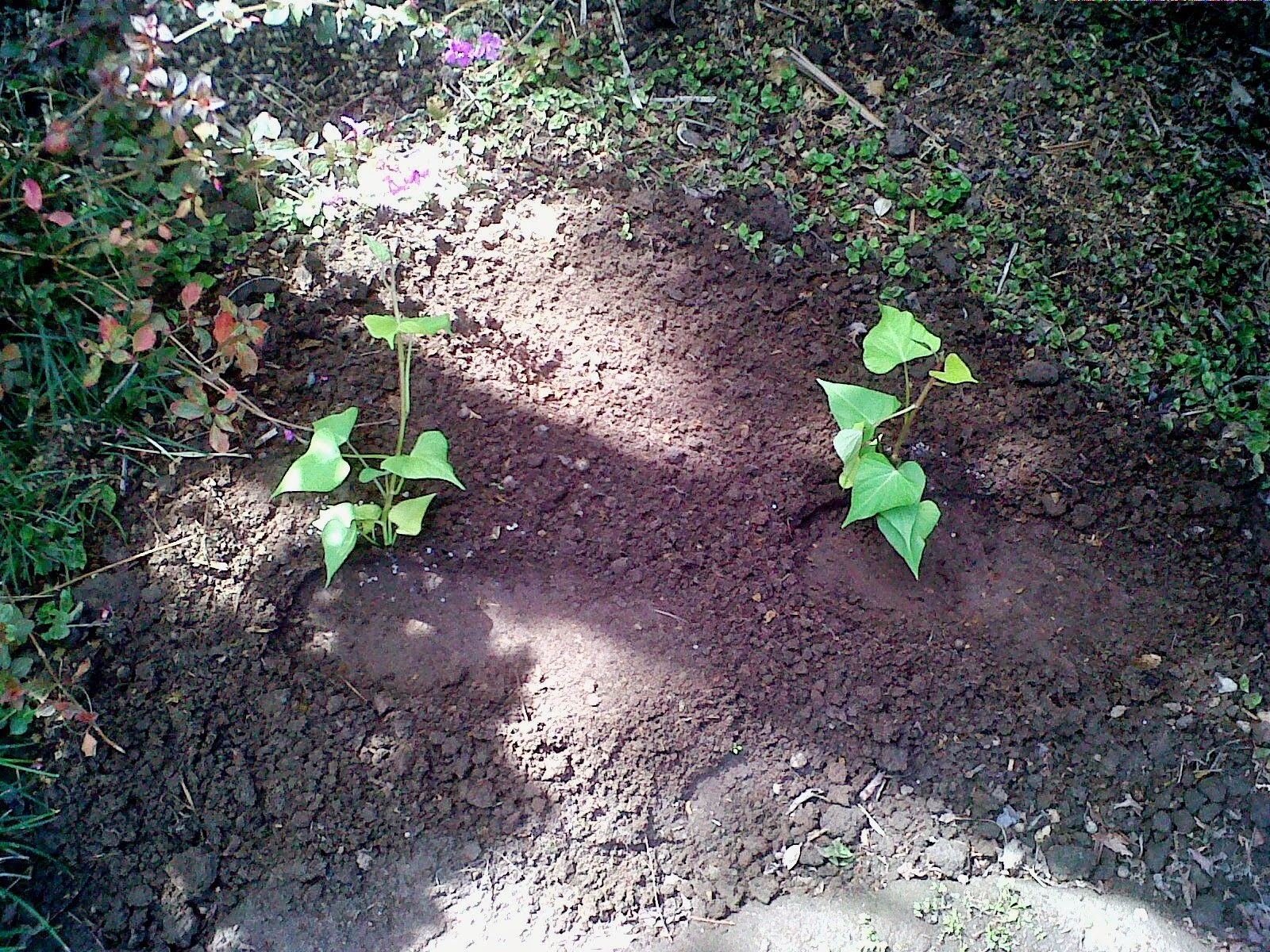
By the beginning of October my slips were ready to plant. You know this is the case when the slips are six inches long or more. Most will have roots on them as well. Simply break the slips off where they're attached to the potato and its ready to be planted. This is how my slips looked on 8 October 2013:
Slips started off from 3 sweet potatoes/Ranke wat met 3 patats begin is
Most of them went into the ground on the same day. Since I'm not blessed with limitless space, they had to go in between shrubs, conifers, between small fruit trees and even partially under the massive swamp cypress. 
Small cleared space for sweet potatoes between the grass, ground cover and conifers
The one thing all sources were in agreement with is that sweet potatoes (Ipomoea batatas) should be left in the ground as long as possible. This is due to the plant being native to tropical regions of Central and South America; therefore requiring warm nights and an average daytime temperature in the mid-twenties (centigrade). I decided I would leave my plants in peace until the beginning or middle of April, since March is still basically a summer month in my part of the Garden Route region. I could afford this luxury because I had planted the sweet potatoes so they could crawl into our normal garden, or just form a kind of green, living ground-cover for the soil in the fruit bed. They would therefore fulfill a dual purpose, because not only would I (hopefully) get to harvest some sweet potatoes, but the dense green foliage would help the soil retain moisture in the height of summer. Neat hey?
Sweet potato bed, instead of fruit bed?/Appel, laventel en kumquat skaars sigbaar tussen patatranke
The after photo (7 April 2014):
The fruit bed, sans sweet potatoes/Vrugtebedding na die patat-oes
Did the fruit bed deliver sweet potato-wise? Yes - over and over! I think it is the first thing I planted that wasn't just a success because it gave me pleasure to plant and harvest my own fruit and veg, but also a financial success... I actually put in way less than I got out. Wonderful!!!
Sweet potato harvest from the fruit bed/Patat-oes uit die vrugtebedding

How did the two slips planted six months before fare stuck between grass, ferns and conifers? Well:

Just as the sweet potato harvest was about to start/Nét voor die patats geoes is
Sweet potato harvest from conifer bed/Patat-oes uit conifer bedding
And so, from three average sweet potatoes I harvested 6kg six months later. I am amazed! This is clearly a vegetable I will plant over and over in my garden. Not fussy, no pests, minimal watering, big harvest. The only thing I noticed, once again, is that they shouldn't be planted in the shade. Partial shade is fine, although full sun (6h+ a day) leads to the highest yields. My biggest single sweet potato came from the sunniest part of the fruit bed. It weighed in at a respectable 750g... unfortunately I sliced it into pieces with the spade. Such is life.