28 September 2014

Favourite Corner - Spring 2014. Gunsteling Hoekie - Lente 2014

I can't believe it's been a year since I last did a "favourite corner" post. How time flies, hey. This time my post will be more focused on a favourite shrub than an actual favourite corner, but the shrub is in a corner, so what the hell...

Japanese Quince/Blomkweper
Chaenomeles japonica is normally grown as an ornamental plant due to its beautiful orange-red to bright-red flowers. They also produce small quinces. Yes, they are perfectly edible. James Wong filled my head with mini-quinces and rumptopf about a year ago now. The rumptopf is still outstanding, as the mini-quinces are still very much outstanding too. 

I must be honest; I have no idea how long this little shrub will take to fruit. I just hope it's not seven years or an equally ridiculous amount of time. Even worse - I hope it's not a "Speciosa" flowering hybrid which doesn't produce fruit. The horror! That's the thing with most South African nurseries: the plants are not properly named and the naming might sometimes even be a bit dodgy. Oh well, let's just hope for the best.

Botanical name: CHAENOMELES JAPONICA
Common name: Japanese Quince/Flowering Quince
Volksnaam: Blomkweper
Native to: Japan
Date planted/sowed: June 2013
Ease to grow: Extremely easy to grow
Costs: The shrub was a gift but costs around R85.00, plus compost of around R10.00/bag
Notes: Grows well in shady spots, but doesn't flower or produce fruit as well


11 September 2014

Apple Tree Pruning. Appelboom Snoei

Let me start off by saying I know know little about caring for fruit trees and even less about pruning them. Less than nothing actually... and the information I gleaned from extensive google searches were so convoluted and confusing I nearly gave up! I still had my Granny Smith apple tree crying out for attention though. It was reaching for the sky really. So what to do? Off I went to my local (and favourite) nursery and enquired there. This is what I learned*:
6 Aug 2014: Pre-pruned Granny Smith/Granny Smith alvorens dit gesnoei is
My tree was seemingly healthy and had lots of first year growth, but had to be topped quite urgently. Late winter is apparently the best time to prune apple trees, so there was no time like the present. Apple trees are normally not allowed to grow too tall, otherwise it would require either a very tall ladder or a very agile toddler to get to the highest, juiciest apples (I'm not in favour of child labour, but obviously my little tree will only support the weight of a toddler :-P ). I read somewhere to cut the tree's top off as high as one's arm can comfortably reach. Noted. Also, that one is supposed to make the cut diagonally so that water would run off the cut, thereby preventing rot. I was furthermore told that I could smear the cuts with honey to seal it, just to make double-sure no rot would occur. Noted. Another good tip is to cut off the main branch(es)/leaders a wee bit above an outside-facing bud. This is to encourage branches to grow outwards from the trunk.

Granny Smith showing two leaders/Granny Smith met twee hoofstamme
My Granny Smith tree also possessed two leaders. In apple-tree-talk the main stem of a tree is called a leader. I thought this would be a major problem, as one strong leader was always preferable, maar 'n boer maak 'n plan. The same friendly nursery owner told me to take a 30cm plank and make circular notches on both ends of the plank for the two leaders to fit in. Then push the plank down in between the two leaders to where it can comfortably go without damaging the stems or tree. Next, tie the plank to the two leaders with stockings. Noted. He also told me to top the leaders about 40cm above where this plank was tied. I topped them a bit higher. I didn't want a midget tree.

All this effort would encourage the two leaders to grow away from each other, and discourage them and their smaller branches to rub against and damage one another. Sounds like a fine idea to me!
Solving the two-leader problem/Oplossing vir 'n gesplete boomstam
I guess the proof in This pudding will lie in the kind of branch growth my tree has later this spring. Let's hope I did the right thing and that I didn't top my tree too high. Damn, who ever knew gardening could be so stressful?!

* I was given detailed advice on pruning and caring for my apple tree, but as I'm an Aries and therefore very   
   stubborn I might've improvised slightly.

13 August 2014

Backyard Harvest. Agterplaas Oes

Yes, I'm still here. The computer might've given in and the winter garden might be coming along very slowly, but I'm still here. Still interested in getting my hands in the dirt, growing some useful fruit and veggies and some random ones, and subsequently blogging about it. The massive delay in this post wasn't intentional, but sometimes technology really gets in the way rather than assisting, don't you think?

Since I'm a bit out of practice I will let the photos do most of the talking. Let me get on with it...
Cape gooseberries/appelliefies, strawberry/aarbei, pepino/boomspanspek, Sugar Ann peas/ertjies
How does that cute chocolate advert go? "I've got joy in my life..." Yes, joy, joy and more joy... my Cape gooseberry bush is producing enough for a daily snack and then some. I've even made a summery fruit salad by adding it to chopped pineapple, paw paw (papaya) and pepino. Yes, the tropical pepino bush is unbelievably producing smack-bang in the middle of winter. What did I say? Joy!

Strawberries are only starting to flower now, so I've eaten the odd one straight from the plants. I've harvested quite a few cute Sugar Ann Snap peas though. We prefer them fresh in a mixed green salad. If you have any ideas what else to do with them, let me know.

Sugar Ann Snap peas/ertjies and Little Gem lettuce/blaarslaai
After last year's disastrous attempt at growing lettuce, this year couldn't make me prouder. Just look at the scrumptious lettuce leaves in the photo above. I grew them in the proper season and in a well-composted container this time though. That might be the reason for my success this year. Maybe not "might" - more a definite. The peas are so deliciously crunchy and sweet, I will definitely plant them again next autumn. I think I will dedicate much more of the backyard veg patch to them though. The harvest wasn't nearly enough for the family. Practice makes perfect, hey?

Cape gooseberries/Appelliefies
Oh boy, I harvested 300g of Cape gooseberries (also known as Inca berries) in one go. From one bush! It was a proud moment. Silly, but proud. Did I mention this was a volunteer bush that just shot up in my backyard veg patch? The same one I gushed about in my June post on the autumn garden.

Broad beans/Boerbone
Although my broad beans aren't really ready yet, there were about ten of them waiting to be harvested. No, the wee offering in my hands isn't the sum of it, but I just had to take a photo. I've never really done anything with broad beans, so I went out on a limb and sautéed them in butter with leeks. It went quite nicely with our "boerekos" chicken, potatoes, carrots and peas. What do you guys do with broad beans? I need some ideas here, but I'm not too keen on tossing them with mint leaves as I've read online. In my house mint is something that belongs in a refreshing cooldrink like lemonade.

I promise to pop in again soon. Why don't you tell me what you've been up to in your winter garden in the meantime?

24 June 2014

Winter Soup. Wintersop

Since the winter solstice is just a few days behind us here in the southern hemisphere I thought a post on soup would be appropriate. A colleague and I always joke about the link between overcast/rainy weather and soup. Yes, the fare in my household is quite predictable. Soup would be a safe bet on a rainy winter's day. It is not the rule, but nevertheless a common occurrence. 

One of my favourite soups (both to eat and to make) is what I call Sweet Potato and Chicken Soup, or simply Winter Soup. It is hearty, delicious and packed with anti-oxidants. The last few sweet potatoes from my haul in April went into preparing the latest batch. Yes, the sweet potatoes I harvested between the conifers and fruit trees.

Let me share the recipe with you. It serves 6-8 people, depending on the size of the pot ;-)
 
Veggies, chopped up and ready to go into the pot/Groente, opgesny en gereed om pot toe te gaan

Winter Soup Recipe:

4x medium sweet potatoes/medium patats
4x pieces of chicken/hoender
1x large onion/groot ui
3x medium turnips/medium rape
6x leeks/preie
3x parsnips/parsnepe
8x carrots/wortels
bunch of parsley/bondeltjie pietersielie
chicken spice, salt and pepper/hoenderspeserye, sout en peper

Sauté onions and leeks lightly
Brown chicken and spices together
Add water to cover chicken and onion mix and bring to the boil
Roughly chop all vegetables and add to pot
Fill the pot with water and bring to boil
Turn heat down to simmer for 2-3 hours
Add parsley 15mins before serving

The recipe isn't an exact science, but your tastebuds should guide you. If the soup tastes bitter, add another sweet potato etc.
Winter Soup - ready to be served with fresh bread/Wintersop - gereed om met vars brood geniet te word

Which soup warms your heart in winter-time?


4 June 2014

Looking back on my Autumn Garden. Terugblik op my Herfstuin

It's now the fourth day of winter here in the southern hemisphere. The weather only changed dramatically today, unleashing cold and wet conditions over the Garden Route. Therefore, I thought it an opportune time to look back on the goings on of my backyard veg patch in the last month of autumn.

The Witkiem broad beans sowed middle April are going strong; reaching for the sky they are. The Carentan leeks look beautiful. I'm very chuffed with them. The Sugar Ann Snap Peas are also doing well, but a little bit less so than the broad beans. I'm worried that they're still so small and straggly, but the granny assures me this is normal. It's "bush" peas after all. Let me show you what I mean:
Carentan leeks left and Witkiem broadbeans to the right/Preie links en boerbone regs
Sugar Ann snap peas in the bottom left hand corner/Erte links onder
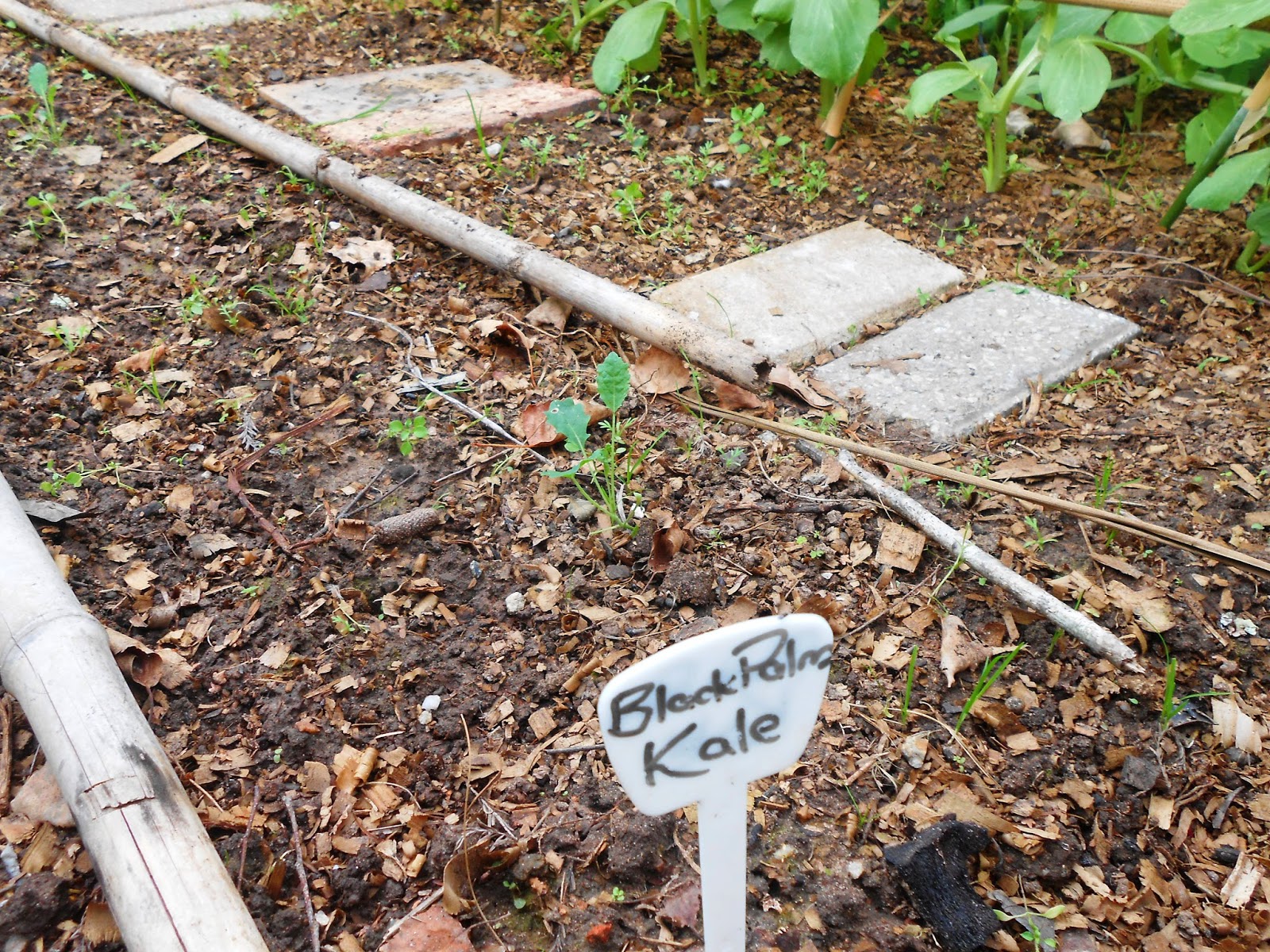
Something that's not doing as well is the kale. I sowed the Black Palm kale just a day later than the peas and broad beans, and yet they are barely 5cm tall. I don't know if it's due to the general scarcity of sun in their neck of the woods in the cooler season or something else. Maybe snails? I'm hoping against hope that the kale is just a slower grower than the broad beans or peas. Some of the latter are situated in parts of the veg patch just as plagued by shadows as the kale. Oh well, at this moment I can just hold thumbs I guess. Does anyone have any idea what I could do to aid the kale's growth? Or is this quite normal for cold-season kale growth?
A teeny tiny kale plant/Eina-klein boerkool plantjie
The tamarillo is doing splendidly, as per usual. The bergwind once again tried it's best to destroy the tree tomato, but it's still standing. Askew, but still alive. The angle with which the tree is growing is actually aiding fruit development, or so I read. This is because the tamarillo makes side branches when at an angle, and these side branches also produce fruit. My tree is full of big, beautiful tree tomatoes. I'm thinking a Foreign Friday entry would be appropriate once I actually harvest some of them. Just look how gorgeous they are:
Tamarillo fruit/Tree tomatoes/Boomtamaties
Another vegetable which didn't do particularly well this time around were radishes. This was a bit surprising as I've found radishes to be so easy before. Well, not anymore! This time almost all of them had long, leggy red roots instead of orbs of peppery goodness. I didn't sow them that long after I worked chicken manure into the garden, so I think the soil might have been too fertile, or the manure still too strong. That, or it was simply not sunny enough. I did manage to harvest one meagre hand full though. It went straight into my Sweet Potato Winter Soup. I will share the recipe at a later stage.
A handful of radishes/Handjievol radyse
Some inroads were made into solving the shade problem. Well, maybe solve is a bit of an exaggeration. I chopped down another cordyline in order for the morning sun to touch my garden a few minutes more. I tried to saw through the tree trunk, but it was not to be. In the end I had to chop it down. I felt like a veritable Huntsman as the wood chips went flying and the axe went deeper into the tree. It took ages, but I conquered! 
Halfway there with the cordyline
Doing it the green way... sweat and aching muscles followed
A while ago I also sowed coriander and Little Gem lettuce in my biggest container. The lettuces don't look as promising as I would want, but the coriander is going strength to strength. We don't really eat coriander leaves, or what the Americans call cilantro, in my home. The taste is way too "volksvreemd" for us, but I sowed it for the seeds. It gives such a great taste to meat and our national favourites; droëwors and biltong (pickled dried meat similar to beef jerky).
Coriander popping its head out/Koljander plantjies pop orals uit

My Cape gooseberry bushes fill me with joy at the moment. I haven't had any success in the year I've had it. Admittedly the wind destroyed my first bush. Just as it recovered, the sun scorched it almost to nothingness. I subsequently moved the container, and it looks happier now. Happier and producing a husked berry here and there. The real success is the volunteer Cape gooseberry which turned into a giant, almost untameable, bush in the backyard veg patch. I've tried to minimise its encroachment into my vegetable area without removing the bush. So glad I didn't take it out; it is Covered in berries! I have dreams of making Appelliefie Konfyt (Cape gooseberry jam), or just munching on the little golden beauties. Can't wait! 
Little Cape gooseberries galore/Appelliefies in oorvloed

23 May 2014

Foreign Friday. Volksvreemde Vrydag

Tomatillos (Physalis philadelphica/Physalis ixocarpa)


When I bought my first tomatillo seeds a year ago (May 2013) I was very hopeful. It was the first seed I bought, and being a naive, first-time veg gardener I thought I would harvest a ton of green and purple tomatillos come summer. By March this year I was ready to pull the whole lot out. One miserable tomatillo. Hopes and dreams dashed.
Middle Feb 2014 - still hoping for any type of harvest
Middle Mar 2014 - hopes dashed...
... one miserable tomatillo harvested by Mid-March 2014
I really don't know what I did wrong with my tomatillos, but I have two theories. One; the sun scorched them, nestled up against the vibracrete wall. Two; the soil wasn't fertile enough. It's difficult to say which one of these theories is the correct one, or if it is a combination of the two. This is because I added tons of compost just as the weather cooled down slightly by the end of March.

In the gentler weather of April I started to notice a difference, and by middle May I had tomatillos everywhere:
15 May 14 - An abundance of green tomatillos!!!
15 Mei 14 - Groen tomatillos in oorvloed!!!
Now I was faced with another problem. You see, after I basically wrote off the tomatillos in March I had set this bed out for brown onions. Only brown onions. The granny told me April is the best month to plant onions in my neck of the woods. April came and went as I waited for the tomatillos to ripen, but by middle May I couldn't delay anymore. Yes, my tomatillos would've been bigger had I harvested them later, but onions are worth more in this household. You see, tomatillos are volksvreemd... onions not. So out went the tomatillos and in went the Texas Granos. 

This is what I harvested:
 
Maybe I should try a simple Salsa Verde recipe now. What do you think?

Botanical Name: PHYSALIS PHILADEPHICA or PHYSALIS IXOCARPA
Common Name: Tomatillo, Mexican tomato, husk tomato
Volksnaam: -
Native to: Mexico
Date planted/sowed: 10 + 18 Oct 2013
Ease to grow: Moderately easy to grow, but I had difficulties getting the plants to fruit
Costs: R11.00 for 35 seeds and about R20.00 for compost
Notes: Compost soil well two weeks before sowing tomatillo seed. Also avoid planting against hot, reflective walls.

9 May 2014

Backyard Farmer Contemplations. Agterplaas Boer Denke

As the autumn season draws nearer and nearer to a close, I thought it appropriate to reflect on my autumn garden. There isn't too much to show harvest wise, except the abundance of sweet potatoes, but let me share with you the goings on in my corner of the Garden Route:
Black Hungarian peppers and Bishop's Crown peppers/Swart Hongaarse en Klokvormige soetrissies
Bishop's Crown peppers in the backyard veg patch
Black Hungarian peppers in the backyard veg patch

Now that the weather is cooler but still warm, the peppers have come into their own. I think I got the green peppers too late in the season to produce, but the Bishop's Crown peppers have stolen the show. Such pretty vegetables, aren't they? Another pepper that has done really well (despite attempts at annihilation haha), is the Black Hungarian pepper. I got these critters from the kind folks at Organic Seed SA. The peppers turn a deep, glossy purple and is really quite mild. Even people who dislike hot food will love this one.
Tree Tomato/Tamarillo/Boomtamatie vruggies

What were only dainty little flowers on my Tree Tomato two short months ago, developed into plump fruits in the meantime. I can't wait to sample some of these fruits. Not only are they delicously strange and exotic, but they are also packed with vitamin A and C. I think they are a valuable and easy-to-grow addition to any South African garden.

Despite hectic berg winds, hail and the occasional downpour my autumn garden is coming along nicely. I hope to share the progress with you next time :-)