18 January 2014

Problems in my Summer Garden. Probleme en pyne in my Somertuin

Sometimes inexperience isn't the only cause for concern in my backyard garden. No, the elements can also take its toll. I planted various beans, including Lazy Housewife and Contender, mid-August and direct sowed an assortment of tomatoes the end of September. Normally these planting/sowing times would be ideal, but last year Spring we had an unusually high rainfall. Followed by an extremely wet January. Yes, we measured 165mm of rain in only the five days between 5 and 10 January 2014. Any gardener knows excess humidity causes one of the most dreaded plant diseases...


BLIGHT!!! ROES!!!

I never knew there were so many different types of blight and that some of the types were more disastrous than others. According to the sources I studied I luckily had a case of early blight in my garden. Okay, maybe no blight can be called "lucky", but at least the early type still meant some sort of harvest, whereas late blight kills a plant outright. The symptoms of early blight are discolored foliage - first yellow and then brown spots, forming concentric patterns, with no 'mould' underneath the leave. It mostly affects the leaves, and the same type of vegetables shouldn't be planted in that area for three years. Late blight attacks a whole plant, makes the fruit rot and has the mouldy stuff underneath the leaves.

As is the case with any type of blight, it is better to simply pull up the whole plant and destroy it. Do not compost! I simply couldn't get that over my heart. After all the months of nurture, watering, sweating, and this...
Dr Carolyn tomatoes/Dr Carolyn geel tamatietjies
Brandywine Sudduths tomato/Brandywine Vleestamatie
The butternuts are probably the biggest disappointment so far. Even though I used organic Waltham seed and planted a borage between the squashes to encourage bees (and oh, were they encouraged!) the little butternuts would all fall off when they were about 5cm big. I also added piles of compost. All to no avail. Then the rains came... shortly followed by an explosion of white powdery mildew. I was fed-up; I wanted to pull the whole lot out. Then the mother showed me this:
A little one, but a butternut nonetheless/My eie botterskorsie; eie en enigste sover
Safe to say that the butternuts are all still in the ground. Covered with mildew, but still producing little squashes. I might be a pessimist at times, but that doesn't stop me from hoping one or two of them will survive, like the little sucker in the photo.

What are your biggest concerns in your garden at the moment?


3 January 2014

Foreign Friday. Volksvreemde Vrydag

Cucamelon/Mexikaanse Suur Komkommertjies (Melothria scabra)


Due to the space limitations of my backyard vegetable patch runner vegetables and fruit like squash, pumpkins, melons, watermelons and cucumbers were never an option. That's until I read about cucamelons on the ever-creative James Wong's site. I read that they resembled miniature watermelons (and therefore were also known as Mouse Melons) and tasted like a mixture between cucumber and lime. Interesting.

Furthermore, they could be grown on trellises, and were apparently rampant growers as well. Sounded like a good deal to me! After quite an extensive search I sourced a few seeds from the online site Organic Seeds for a very reasonable price.

The seeds went into a large container filled with compost and manure enriched potting soil. I planted them middle September, and by the end of September virtually all of the seeds had germinated. At first the plants seem to be slow growers, but after they started to form their first tendrils, they shot up virtually over night. By mid-November, my cucamelons looked like this:
Cucamelons, with chives and peppers as companions
By December I wanted to cry in frustration. The same cucamelon forest that looked so promising initially, looked terrible. I made a mistake many novice gardeners do; I planted them in the wrong location. The cucamelons trail up directly against a north-facing wall, and the sun ruthlessly burned all the top leaves and new growth. Most of the dainty yellow flowers simply fell off  due to the radiating heat. NO!!!
Sun damage to cucamelon bushes/Sonskade aan my arme Mexikaanse Suur Komkommertjies
On Christmas Day 2013, therefore, I was very glad to see at least one cucamelon developing. Even if only to taste them and see whether I would give them a go again next year.
Small cucamelon developing
It's now early January 2014 and my first cucamlon harvest came in. A measly three, but a harvest nonetheless. Note to self; never plant cucamelons, or any trailing vegetable or fruit for that matter, directly against a north-facing wall!
Thee little cucamelons/Drie Mexikaanse Suur Komkommertjies
And the verdict? They taste surprisingly refreshing and have a lovely crunchy texture. I would say much more cucumber than lime, but way crunchier. I will definitely plant these mini-cucumbers again! Have you planted anything exotic recently?

Botanical Name: MELOTHRIA SCABRA
Common Name: Cucamelon, Mexican Sour Gherkin/Cucumber, Mouse Melon
Volksnaam: Mexikaanse Suur Komkommertjie
Native to: Mexico and central America
Date planted/sowed: Mid-September
Ease to grow: Grows easily, but requires sun and something to climb over
Costs: R20.00 for a packet of 15 seeds
Notes: Plant away from a wall receiving full sun, and space farther apart (15cm or more)


2 December 2013

Spring Harvests. Lente Oeste

With it already being the second day of summer here in South Africa, I thought it appropriate to report back on what I harvested in my backyard garden (and also in other patches scattered throughout) during spring. While some vegetables performed quite well, others were simply not suited to our Garden Route climate, or suffered because of my inexperience and a lack of sunshine. This is what I harvested:
 
End Sep 2013 - nasturtiums, strawberries and "cauliflower"/kappertjies, aarbeie en "blomkool"
The first plants to produce anything vaguely fit for "harvest" were nasturtiums I sowed late July in a container and strawberries the granny and I planted late May and late June. Nasturtiums are always rampant growers, so I didn't expect anything less of them. On the other hand; I am currently planning to replant my strawberries in the soil, because they're not producing as they should in their pots, but then again; maybe their pots are too small. Questions, questions... I won't even mention the cauliflower, as they were a total failure. Of the twelve plants I purchased and planted late May, I didn't get one decent-sized cauliflower head. The biggest one was about 2cm x 2xm! I think I planted it too late in the year, because they got some sort of fungal disease. Perhaps I should plant them earlier in autumn next time?

Start of Oct 2013 - Some of the radishes/Sommige van die radyse
Radish was the one vegetable that performed brilliantly in the garden. Such a quick perfomer as well! I sowed them mid-August and harvested these beautiful babies in the beginning of October. How chuffed was I! The one thing I learned for myself is that they perform miserably in shady areas. Radishes I planted between my broad beans, in a mostly shady area, could only be harvested two weeks later than the ones in full sun, and were stunted and small. Yes, all sources told me most vegetables don't work well in shade, but I had to see it for myself, okay. Haha

Mid-Oct 2013 - An abundance of parsley/Pietersielie vir Afrika
Parsley, parsley and more parsley! Yes, parsley was definitely the biggest star in my spring garden (and I have the dried bottles of parsley to prove it). Both the curly-leaf and Italian varieties performed well, although the latter out-shined the former to an extent. Now that it is summer I'm having problems with them going to seed, but that is to be expected I suppose.

End Oct 2013 - Meager broad bean haul/Skamele boerboon oes
Yes, I made the same mistake with the broad beans as with some of the radishes... too much shade! What started out as a beautiful bed of beans under a leafless Acer negundu tree in autumn, turned out to be the aphid-infested bane of my existence under a fully-leaved Acer in spring! Regrets, regrets! Especially because the little broad beans I could harvest tasted so heavenly in one of the mother's Cape Malay curries. Ai! Note to self - plant broad beans beginning of autumn in a sunshiny spot next year!

Start of Nov 2013 - Lots of leeks and lettuce/Pragtige preie en baie blaarslaai
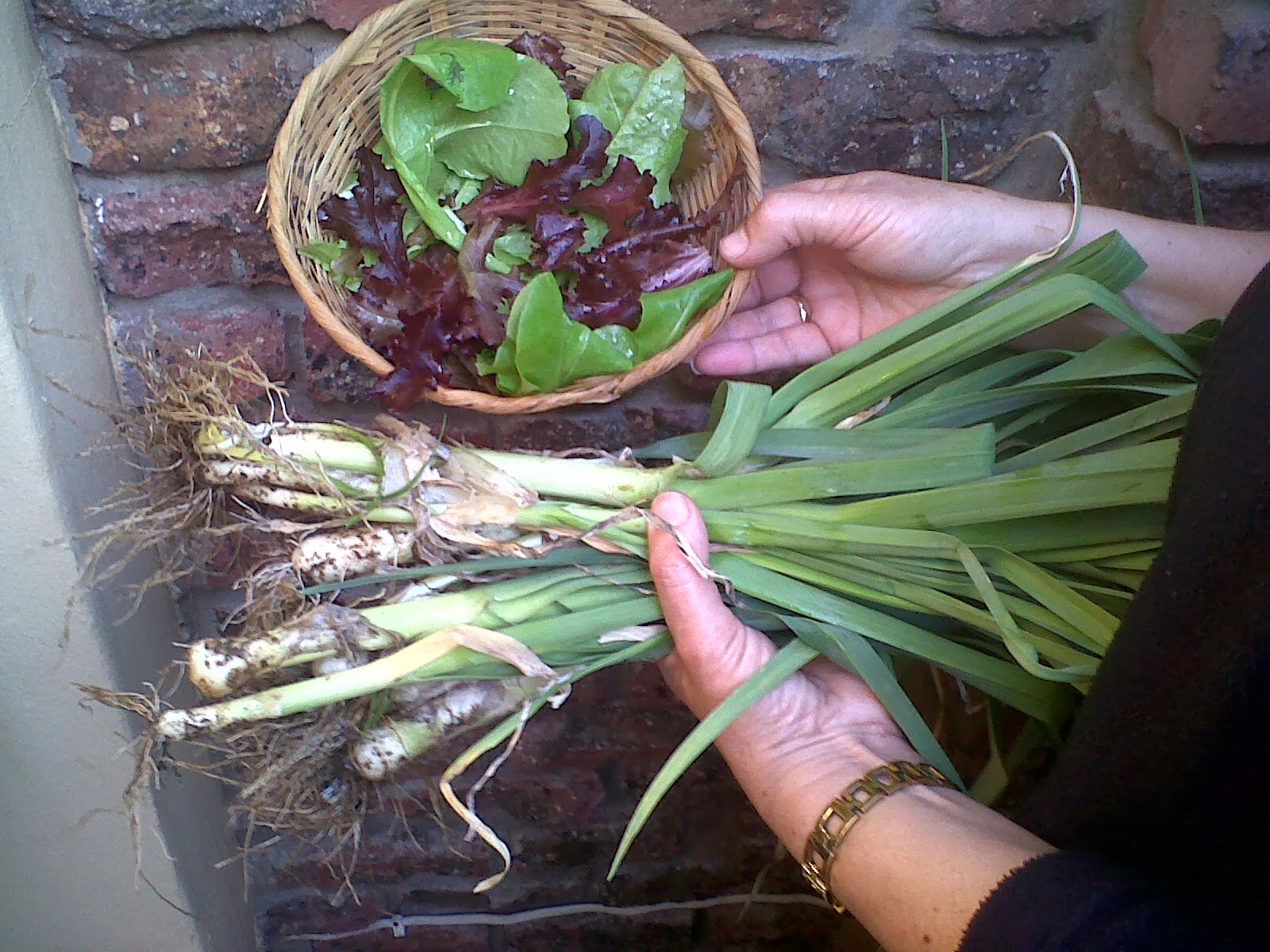
In addition to the parsley, leeks and lettuce were the other two members of the trio of top performers. Lovely green and purple lettuce bought at Norgarivier Nursery and planted in the beginning of October went into beautiful green salads. The leeks went into a gorgeous Leek, Bacon and Cheese Pie. The family couldn't get enough! Basically you pre-fry the leeks in butter, add it and grated cheddar, a carton of cream, a packet of half-cooked bacon and two eggs to a pie tin, in pastry, and voila! If you don't have enough leeks (like I did), sommer add a few normal diced onions to taste. Works like a charm.

Mid-Nov 2013 - Pole and bush bean harvest/Rank-en bosboon oes
Beans always perform well in our backyard garden, so I expected nothing less this year. This year I planted white pole beans, Contender bush beans and Lazy Housewife pole beans. In the photo, the larger, flattish beans on the left are the Lazy's and the thinner ones are the others. I got the organic Lazy's at Livingseeds - a highly recommended organic seed store. The white beans and Contenders I got from another kindly neighbour. 

We have already enjoyed all of them as green beans and some of them have been blanched and frozen. Now I can't wait for the bushes to perform even better, so the granny can make a decent batch of curried beans yummy!


I planted twelve red onion seedlings during the last week of May, and about the same number of Australian Browns the first week of June. The red onions performed quite well, but the white onions produced the smallest onions imaginable. We harvested them all the very end of November.
The lesson I learned from this comparison? Do not plant onions in hard-as-nails and compacted soil!

Hope I haven't bored you all with this lengthy post, but I guess someone out there might pick up a tip or two from my successes and failures. What do they say; practice makes perfect.

20 November 2013

Favourite Corner - Spring 2013. Gunsteling Hoekie - Lente 2013

Although I'm more of a winter person, Spring is probably the most beautiful season in any garden. The abundance of flowers, new growth in the backyard veg patch, new shoots on trees and iridescent green leaves on deciduous ones. What's not to love?

I want to take this chance to share my favourite garden corner of the season with you:
My favourite corner/My gunsteling hoekie
It's actually a wild mix of grasses, ground cover, indigenous plants, self-seeded volunteers, a huge trunk and an unidentified bush. Oh, and some stones added for effect. I think the result is quite striking. The mother can take most of the credit for this creation though. Can anyone identify the big shrub behind the trunk?

Originally, only pink impatiens was planted, but the bush somehow multiplied into normal pink, dark pink, white and variegated impatiens. Wonderful!
Impatiens galore
The ground cover plant in this spot is Mexican Daisies, or Erigeron karvinskianus. Quite a mouthful for such a petite plant. It might have petite pink and white flowers, but it's an aggressive grower. It survives even the worst neglect and water shortages. A great bonus in an often-neglected garden *blush. 

Dis nie soseer uit pure nalatigheid nie, maar aangesien ons area al deurgeloop het onder erge droogtes is dit slim om waterwys te plant. The neglect is not always voluntary, but sometimes due to serious droughts in our Garden Route area. Therefore I would recommend the Mexican Daisy to all gardeners in this region of South Africa:
Mexican Daisies
The latest addition to this spot, as I wrote about previously, was a Clivia. How happy am I that it turned out to be a red one! Weereens dankie aan 'n dierbare Tannie vir die geskenk!
Red Clivia and pink Impatiens
Do you have a corner in your garden that just makes you happy instantly?
 

12 November 2013

Fruit Trees, Bamboo Battles, etc. Vrugtebome, Rateltaai Bamboes ens.


Identifying a bed for Fruit Trees


My dreams of partial self-sufficiency did not just stretch as far as a small vegetable patch and a few Num-Nums or Natal Plums. Oh no, I wanted two or three, or more, fruit trees as well. Yes, I did plant a Japanese Quince and a Cherry Guava early on, but I wanted less exotic fruit as well. Fruit we ate a lot, like apples. 

Realising this dream proved more difficult than anticipated. The various obstacles to my plan included space, shade and too many other useless trees and shrubs. A plan of action had to be worked out of course, and that would start with the Swamp Cypress...

De-branching the Swamp Cypress


As I discussed in my post on container gardening, I have a bit of a space problem. Not only because I have an urban garden, but also due to the already established trees in it. The biggest thorn in my side is our Swamp Cypress. It is a beautiful tree, but the parents and I receive endless complaints about how it covers a substantial part of our street in a carpet of orange leaves in autumn and winter. The complaints generally come from the very same people who park in its shade in summer. Such is life. The other problem is how massive it is, both in canopy and root size. Therefore a few roots, and all the lower branches had to go. 
1 Sep 2013 - Before picture of the Swamp Cypress/ en die toekomstige vrugteboom bedding

 The first part of this mammoth task was to get rid of the branches. This part wasn't as tough as expected. The next part of the task would prove to be the back-breaker, though.
15 Sep 2013 -New and improved Swamp Cypress

The second part was to remove the biggest cypress roots in the bed I wanted to use for my fruit trees. This had to wait awhile though, since there were some bamboo reeds and ferns to get rid of first. Ai!!!

Getting rid of Bamboo and Ferns

2 Sep 2013 - The bamboo bush in all its glory

Major drama! Sweat, more sweat, and even a little blood was involved, but luckily no tears. A process that started early October...
4 Nov 2013 - Almost done decimating the bamboo

   ... and only finished early November. 7 November 2013 to be exact; a date of celebration...
7 Nov 2013 - The end; just landfill remaining
Needless to say; I will NEVER plant bamboo again. Ever! 
Bamboo/Bamboes? Never again/Nooit weer nie!!!

Composting the Apple and Kumquat Bed


The last part, but by no means the least, was preparing the bed for my fruit trees. A process I only finished with mid-November. I blame those bloody bamboo reeds! Luckily I had a few companions to keep me occupied while doing this. Not only the mom and granny, but also a few Cape Wagtails (Motacilla capensis), or Kwikkies as we know them in Afrikaans:
A Cape Wagtail keeping me company/'n Kwikkie hou my geselskap

 Choosing Fruit Trees for my Urban Garden


What type of fruit? Which cultivar? What size? Questions, questions... Two of my favourite nurseries Norgarivier Kwekery/Nursery and George Kwekery/Nursery convinced me I needed two apple trees for a successful harvest. Hence, I bought two. A Granny Smith and a Golden Delicious. They are apparently excellent cross-pollinators. See, apples are so fussy you can't even plant two of the same type. No sir, you need two different cultivars. 

The other fruit tree I settled on was a kumquat. The granny and I are major fans, although the rest of the family isn't too keen. Well, space being the problem that it is, forced my hand really. I wanted something smallish, hardy and useable. Kumquat it will be. Once again, thanks to the wonderful Norgarivier Nursery on the Airport road near George.
Sep 2013 - The original spot for the Kumquat

The Planting


Unfortunately I've had to make a tough decision. Alas, our garden only has space for one apple tree (barely). Hopefully the Golden Delicious will find a nice spot in a friend's garden. The Granny Smith I'm definitely keeping. Luckily I've read that said apple trees are self-fertile. Yes, it will fruit better with another apple to cross-pollinate with, but I would get to harvest delicious Granny's with one tree as well. The kumquat will maar have to be its neighbour shame.
Oct 2013 - Die Granny Smith Appelboompie
I hope all the hours of back-breaking work and the endless amount of blisters, scrapes and bruises will be worth it. Somehow I think it will. And here are the results of the (semi-) finished bed:
12 Nov 2013 - Fruit bed/Vrugte Bedding

Fltr - Granny Smith, Boysenberry, Kumquat
I decided on chives and lavender as companion plants to my apple, blackberry and kumquat. Apparently most pests detest the strong fragrance of these plants. I planted chives around the apple and kumquat and a row of French lavenders on the edge of the bed. 

Do you believe in Companion Planting, or use it at home?

1 November 2013

Foreign Friday. Volksvreemde Vrydag

Strawberry or Cherry Guava/Aarbeikoejawel (Psidium cattleianum)


One of my most vivid childhood memories is of the Cherry Guava tree we had in the backyard. I can remember the sweetly tart strawberry-like taste, the amount the brother and I used to gobble down, and the smell of overripe guavas in the hot South African sun. Unfortunately the tree had to make room for extensions to the house, but the memory is still clear.

When I couldn't seem to find a Chilean Guava anywhere in the country, it was therefore not a giant leap for me to settle on the Cherry Guava as stand-in. I blame James Wong for publishing such a delicious-looking guava and quince Rumtopf recipe on his site, made with the fruit of an impossibly difficult plant to source! 

The folks across the water tend to call our Cherry Guava either a Strawberry Guava or a Cattley Guava, but I'll stick to my Proudly South African roots. The tree grows easily in just about any soil, although some organic material and free-draining soil is a must. It grows into an average sized shrub to small tree, depending of the area you live in and the climatic conditions there. Here, in the Garden Route, they tend to grow to between 2m and 3m tall. The tree fruits heavily, and the fruit itself is very nutritious and low in calories. It contains around 60Kcal per 100g.

As I blogged about before, I decided to plant my Cherry Guava in the front-yard garden. I was quite fortunate to get a tree which already had a few fruit on it from my preferred local nursery. Before you pop one of these little treats in your mouth, just heed my warning about fruit-fly bites. The fruit might look normal from outside, but inside it could well be infested with worms. Unfortunately flies and birds like the little deep-red guavas just as much as we do...
My very first Cherry Guava/My heel eerste Aarbeikoejaweltjie
So in went my little tree, and I couldn't be more happy with the result. It took off like a duck to water.
The granny watering newly planted Psidium cattleianum
Since I knew about, and experienced first-hand, the fly problem with the Cherry Guava, I decided to give companion planting a go. At least, I planted a trap crop of nasturtiums and hoped for the best. Dalk was die kappertjies nie die beste keuse nie? The fact that the trap crop I chose normally traps aphids didn't put me off at that stage. I just wanted some nasturtiums damn it! I will definitely add some chives and the like later to repel the pesky fruit-flies though.
Nasturtium seedling/Kappertjie plantjie
Companion planting at its best??? Aarbeikoejawel + Kappertjie???
Oh, how I can taste Cherry Guava Cordial and Guava Crumble already! The following recipe especially appealed to me when I walked across it on another local blog -

Cherry Guava Apple Crumble:

  • Make Cherry Guava pulp by boiling a colander full of guavas, a cup of water and two tablespoons of sugar for 20mins, strain. The mass should be a thick pulp.
  • Crumble:
    • 300g plain flour
    • 175g sugar
    • 200g soft butter
  •  Filling:
    • 450g peeled, cored and sliced apples (tinned apples make a fine substitute)
    • 1tb sugar
    • 1tb plain flour
    • pinch of cinnamon
  • Method:
    • Preheat oven to 180 degrees Celsius
    • Make the crumble by adding the flour and sugar together and rubbing the butter in
    • Add all the filling ingredients to a large bowl and stir well
    • Grease a 24cm dish and spoon the filling in, then pour Cherry Guava pulp over
    • Sprinkle the crumble on top
    • Bake for 40-45mins

Will you be planting a Cherry Guava in your urban garden?


Botanical Name: PSIDIUM CATTLEIANUM
Common Name: Cherry Guava, Strawberry Guava, Cattley Guava
Volksnaam: Aarbeikoejawel
Native to: Brazil (tropical Amazonian regions)
Date planted/sowed: Planted late June 2013 (winter)
Ease to grow: Very easy to grow
Costs: R45.00 for a small tree
Notes: Tree fruits quickly, but need to guard against fruit-flies and birds

29 October 2013

Growing Clivias in the Garden Route. Clivias vir Afrika in die Tuinroete

By this stage you must all think my garden only consists of broad beans, exotic fruit and an assortment of other vegetables. Oh no, that is not the case at all!

My parents have always been fervent gardeners, with our garden once being the pride of the neighbourhood. After a few years of neglect, this was not the case anymore. The garden still had its joys and beauty, but it was all a bit wild, tangled and overgrown. Luckily my new-found passion for gardening wasn't limited to produce though, but also included the bigger "normal" garden. As I now owned the house, I wanted to restore the garden back to its former glory.

Part of this strategy was to jazz it up with a dash of colour here and there. The problem in my urban garden was the lack of sunlight. My parents planted various trees, especially cordylines, (what we sommer call:) wild banana trees, conifers, palms of all sorts and a massive swamp cypress way back. 

So which plants or flowers could I plant in shade, with minimal water needs and maximum colour impact?

My answer was Clivias. Indigenous, water-wise, and fully shade-tolerant? Yes, Clivias were certainly the answer!
Two Clivias already established in the garden - proving some plants flower beautifully in shade

'n Clivia, met sy rooi sade
I already had two huge Clivia bushes in my front garden, and two smallish ones in the backyard garden. Now I just needed a dozen more... maybe two dozen? How happy was I that not only was my best friend's mother part of our local clivia club and therefore had tons to share, but that she was willing to share. And share she did!
Just part of my Clivia haul... Ek sal ewig dankbaar bly Tannie :-)
I had grand plans for creating visual features in the garden, and giving a bit of colour to a pathway's borders. And That is when the hard work started! Who ever thought gardening is such WORK?! Need to loose a few kilos and considering joining a gym? Don't! Start gardening, or better yet; help someone else in theirs. You'll see the difference within a month. I promise!

Firstly, I gave a sad spot in the garden a breath of life by adding two Clivias. I think the mixture of green shrubs and ferns, white rocks, a greyish-brown tree trunk, pink impatiens, blue iris, orange Clivias and ground cover works quite well. What do you think?
A new Clivia next to the road and one planted underneath the big tree trunk
Secondly, I planted one of the bigger newly acquired Clivias in a corner that was just too dull for my liking. It consisted of green, green and more green. Albeit different shades of green, but green nonetheless. Two different conifers, a wild banana, delicious monster and a few ferns had two Clivias added to them. And the result???

Lovely red Clivia as focal point in my green corner. Pragtige rooi Clivia as fokuspunt in die groen hoekie
Lastly, I wanted to beautify a pathway we already had in the garden. The pink Bottlebrush provided stunning colour to that corner, but the path just needed something along the edges to zhoosh it up. In went more Clivias:
The completed, yet still not established, effect

Clivia border along a pathway strewn with Bottlebrush flowers
 Have you planted any indigenous flowers or plants recently?