12 March 2014

Autumn Backyard Garden. Herfs Agterplaas Tuin

My garden is in its transitional phase at the moment. Some summer vegetables are still producing, some are barely clinging on, most are dead, and I am itching to start planting autumn and winter veggies. 

Preparation is key to planting in any season, so I started by working over the bed where my butternuts were, and added some beautiful black gold. Yes, I did go for that turn of phrase because the alliteration has such a nice ring to it... Okay; the 'black gold' I'm referring to in this instance is chicken manure (chicken poo). I bought it at one of the only truly organic chicken farms in the Garden Route area; Red Barn. Go and check it out for yourselves people. The owner doesn't use any nasty antibiotics or chemicals and her chickens are free range in every sense of the word. The bed is nearly ready for the onions I will be planting there in April. I must still just pull out the miserable tomatillos and add some sand. This is how the bed looks now:
Chicken manure added to Onion Bed/Hoendermis by Uiebedding ingespit
 ... and this is why I said "miserable tomatillos":
My one and only tomatillo/Die som van my tomatillo oes
I can proudly say not everything is a miserable failure at the moment. Some plants actually still produce, even if the harvests are mostly meager. The star in my little Garden Route patch is still the pepino, as ever. I have also harvested volunteer cherry tomatoes constantly, but I can't take much credit for these. They are virtually indestructible! We are also enjoying the occasional bunch of Contender beans. The granny picked another 300g the day before yesterday, and we just had it in a gorgeous sweet curry with potatoes, cabbage, carrots, and meat yum :-)
Harvest:  450g pepino + 150g cherry tomatoes + 2x cucamelons
Let me take you on a quick tour of the rest of my garden...

The Delicious Monster starting to fruit/Vrugte aan die Monstera deliciosa
Our Delicious Monster (Monstera deliciosa) plant is clearly not past its fruit-bearing age, as I previously thought. I cannot wait for these babies to open up and ripen!

Cherry Guava covered in fruit/Klomp klein vruggies aan die Aarbeikoejawel
The little Cherry Guava/Strawberry Guava (Psidium cattleianum) tree is such a star. It has loads of little guavas, just 6 months after it last bore fruit.
 
Two hiding cucamelons/Die Mexikaanse Suurkomkommertjies kruip goed weg
I might have done exactly all the Wrong things as far as the cucamelons (Melothria scabra) go this year, but luckily I spotted a few small ones hiding behind dense leaf coverage. Yes, I will try them again later this year, and this time I will do it right!
 
Bell Peppers/Die klokvormige soetrissies begin dra
I have a suspicion these bell peppers might already be a strange hybridisation, as the granny used to grow all types of capsicums in close proximity. My motto: who cares, as long as they taste nice, hey?
 
Tamarillo flowers/Boomtamatie blommetjies
Since I bought my Tree Tomato (or tamarillo as Kiwi's call them) in May 2013 it has literally reached for the sky. The tree is now taller than my 6ft1, the leaves are humongous and yet I haven't picked one single fruit from it. Is this normal? I wouldn't know, but my granny certainly had a mouthful to say about it. I'm sure the words "pull out" have entered her mind. Luckily disaster seems to be averted, as I have spied some petite flowers up top. Is this a sign of juicy tamarillos to follow?
 
Another Black Hungarian Pepper/Nog 'n Swart Hongaarse Soetrissie aan't vorm
This will be the second little Black Hungarian Pepper to be harvested. It might have been more if I didn't accidentally destroy most of the plants. An honest mistake due to it looking suspiciously like yet More purple tomatillos... whoops!
 
Yet another ripe pepino/Nóg 'n boomspanspek is gereed om te pluk
Not much more to say about this one. Yes, the pepino is officially the gift that keeps on giving :-)
 

4 March 2014

Cold Season Garden Planning. Koue Weer Tuin Beplanning

I started avidly growing veggies in my backyard about 9 months ago, in the depths of 2013's winter. I was so eager to start, that I totally ignored the time of year and therefore got miserable results. Results which should have been expected, but nevertheless disappointing beyond belief. Yes, most new gardens are over-eager and make the fatal mistake of focusing on the vegetables/fruit trees/plants, instead of the soil. All the research I did beforehand warned me of this fact, so I had no excuse.

I won't make the same mistakes again, or I will at least try to improve on what I did wrong last year. Planning is one thing I'm very good at; sometimes so good that I plan and plan and plan, but never really implement. A character flaw I know. This is how the planning for my autumn and winter garden is coming along so far:

Calculating how much space you have

This was the logical first step for me, since the available space (and the type of space) will tell you the type and quantity of vegetables to plant. No simple task for me, as most of my space isn't square or rectangular beds, but have weirdly winding or circular edges. Blame my parents for their creative garden planning! For any other person this wouldn't be such a hassle, but I'm a sucker for precise calculations and mathematical formulae. Yes, I'm not only a garden geek, but a geek geek as well haha. After countless tries with a broken tape measure, pen and paper, and even calling in the help of a genial best friend (those damn formulae!) I had calculated my veg garden size to near precise dimensions. And so the real fun began...
 
Backyard Veg Patch - cold season crops to follow/Lappie vir herfs en winter groente

Deciding on which veggies or varieties to grow

The four factors which influence me on what to grow and where to plant it, are;
  • What do I like to eat? More specifically, what does my family like to eat?
  • What worked in my (or the granny's) garden before?
  • Which plants or vegetables benefit most from each other? (Companion Planting)
  • Which plants or vegetables are most suited to my soil type and amount of shade?

Drawing up a Garden Plan

This is one step that small-scale backyard gardeners don't have to spend too much time on. Being the kind of person that I am, I've spent hours and hours planning, calculating, drawing and re-drawing my very first Garden Plan(s).

I only have three spaces suitable to vegetables and the occasional fruit tree; they measure:
  • 6.1 sq meter (of which 4.8 sq meter can be used due to perennials)
  • 7.8 sq meter (of which 1.4 sq meter can be used due to shade and trees), and
  • 1.52 sq meter (all suitable for planting)
This leaves me with only about 15.5 sq meter. Not much by any stretch of the imagination, so therefore pre-planning is vital to optimise my space.

The most wonderful tool I've discovered online is the GrowVeg Garden Planner. Not only is it free for a 30-day period, but all features are available to users of the free trial programme! The first step in the design is to tell the programme the length and width of your bed. Then you simply choose a veg/fruit/flower type and plan out the rows or blocks desired. The nifty little programme will tell you automatically how many of said plant you can chuck into said space. Marvelous!

Here is an example of my backyard vegetable patch:
Backyard Veg Patch Plan/Agterplaas Tuinplan [copyright www.growveg.com]
See the full plan, all suggestions, and how wonderful this site really is at GrowVeg.com

Preparing the soil

As soon as the summer veggies and flowers start looking a bit straggly and production comes to a grinding halt, it is time to pull them out and either compost or destroy them, depending on whether they are still healthy specimens. This normally happens the last month of summer or in early autumn. In areas where chilly weather comes sooner (like the Free State or Gauteng) it would most probably be end Feb, and the Garden Route area where I live it's more likely to be March. There is no hard and fast rule to the month of the year though. 

From Pumpkin Patch to Onion Bed/Toekomstige wit-ui tuiste?
Now comes THE MOST IMPORTANT TASK IN GARDEN PLANNING... Soil preparation. It is very important to spend most of your available finances on preparing the soil well and the smallest amount on buying plants or seed. The type of soil you have is also very important. This is because you will need to add coarse sand to hard, clay soil or huge amounts of compost to loose, sandy soil. I have a mix of good garden soil and heavy, clay soil in my own garden.  

A rule of thumb is to add two bags of good, organic compost to a square meter of your garden. That is roughly equivalent to 2'' of compost (5cm) on top of your bed. It is also a good idea to add a complete fertiliser to your garden. 10-10-10 fertiliser is the best one to go with (equal amounts of nitrogen, phosphate and potassium). Manure is an alternative to compost, but must be well-rotted. A good indication on whether it is suitable for your veg patch is to smell it. If it doesn't reek to high heaven, it apparently is black gold!
A scattering of red onions to follow/'n Paar rooi uie midde-in die vrugte bedding?
All the preparation stuff must be done at least two weeks before any planting. I've just realised it's already March, and I haven't done even a square foot of soil preparation. I will definitely have to order a bakkie-load of compost from Norgarivier Nursery, some fertiliser... and get in my garden, sweating away!

17 February 2014

Backyard Harvest. Agterplaas Oes

I think a report on my harvests is long overdue. Don't let the word "harvests" fool you into thinking massive, farm-scale hauls however. No, the produce harvested in a backyard garden is much more humble. It still leads to pride and joy - especially if the harvest is larger than expected. An occassion that, admittedly, didn't occur very often in my little South African patch this summer.

So here goes:
Clockwise fltr: Gem Squash/Skorsie, two Pepinos/twee Boomspanspekke, tomatoes/tamaties
One of the most successful plants in my backyard veg patch isn't a vegetable at all, but the pepino. It's like the gift that keeps on giving. I get at least one juicy pepino every week from a bush less than knee-height. Plant it if you live in a sub-tropical or moderately humid region people!

The gem squash wasn't through any effort of my own. No, a volunteer plant sprung up under my little kumquat tree. I think the manure-enriched compost might have something to do with it. The plant soon lost the fight against white powdery mildew, but not before providing us with two lovely squashes. Two might be a meager amount, but they were unexpected, so I'm appreciative.

The tomato haul has been bitterly disappointing. Blight of course. The only tomatoes that seem to flourish are the volunteer cherry tomatoes, and even they got blight in the long run.

Clockwise fltr: Brandywine Sudduths, Red Kaki, Dr Carolyn Yellow
The Red Kaki tomatoes (dark-green round tomato pictured centre-right) were a complete flop. The plants all got blight too early for the poor little tomatoes to flourish. At least I received the seeds for free haha. The blight is definitely to blame, but this cultivar seemed the most prone to it. I don't think they will get any of the valuable garden space in future.

I got some decent-sized Brandywine tomatoes. The plants also developed the dreaded blight, so most of the tomatoes had to be harvested greener than should be, but their taste was  great. No fake taste, like all those beautifully plastic-looking shop tomatoes. They are a bit mushy for my taste though. I think I will try another fleshy cultivar next year. Any suggestions?

The biggest surprise has been the Dr Carolyn Yellow tomatoes. I harvest at least a handful every day. They also lean to the mushy side when over-ripe, but they produce like little machines! They also look beautiful in salads. I don't know if this is pure coincidence, but they also seem more blight resistant than the other cultivars I tried this year. Think I will give them a go again next year.

How does your summer harvest look thus far? Winter harvest, if you're living on the other side of the equator?

6 February 2014

The Joys of Summer Gardening. Vreugdes van 'n Somerstuin

I did complain extensively about all the woes and problems summer heat and humidity causes in a garden, but it's not all doom and gloom. Yes, white powdery mildew explodes on cucurbits and blight attacks almost everything, but the warm season brings on its own joys and beauty.

Nowhere is it more evident than with all the flowering plants. I would like to share with you a few photos of the blooms in my little Garden Route garden:
Carnations/Angelier (Dyanthus caryophyllus)
I must confess that the Carnations are the granny's babies. She nurtures them every day, and look how gorgeous they turned out to be! I simply love the intoxicating scent of them - daardie eksotiese mengsel van soet blommegeur en speserye. The botanical name for carnations 'Dianthus' means Heavenly Flower, and yet it is also a symbol of socialism on the one hand and bad luck on the other, in Francophone countries. What a contradiction!


Peace Lily (Spathiphyllum)
A Peace Lily's leaves are so glossy it always reminds me of a good imitation plant. It's simply so beautiful and shiny; with the weirdest little white flowers. Weird or not, these plants are a good solution to those troublesome shady corners. This is because peace lilies don't need much light or water.


Miniature  Pansies/Miniatuur Gesiggies (Viola x wittrockiana)
Pansies just have a way of cheering me immediately. I mean, who couldn't love them? Especially in their cute miniature form. The Afrikaans name for pansies make them sound even cuter; 'Gesiggies' (little faces). Adorable right? These are more commonly referred to as violas, but nevertheless the same species as those big annuals. 

Foxgloves/Vingerhoede (Digitalis)
After I saw a stunning garden layout in the Garden & Home magazine, I simply HAD to have some foxgloves in my garden! The photo above is of the first one that flowered. In this one instance I like the English and Afrikaans names equally. In Afrikaans they are called 'Vingerhoede'. A 'vingerhoed' is a metal cap used in the olden days to protect women's fingers from needle pricks. Since this flower resembles the shape of that little thingamajig I suppose the name was a logical fit.

Inca Lily/Inka Lelie (Alstroemeria)
When I started with my veg patch and fruit gardening I took it upon myself to destroy most of my mom's Inca Lily bed. It has one of the most invasive tuber root systems I have ever seen. It's nearly impossible to get rid of them! A single piece of tuber in the ground leads to a lily popping up later. As always, the hardiest plants come from South America. It's not all that bad when you're rewarded with flowers as gorgeous as this though, is it?


Impatiens

The wonderful thing about Impatiens is that they seem to multiply into different colours; some of which turn out to be variegated! We plant a pink impatiens, and its flowers turn out to be cerise pink, purple, orange and... Wonderful! The one thing to always remember however, is that these little plants are not water-wise in any way, shape or form.
Bird of Paradise/Strelitzia
In addition to numerous clivias, I also have a few other indigenous plants in my garden. The Bird of Paradise might have one of the strangest, but most beautiful flowers. It certainly does resemble the bird its English common name is linked to, doesn't it? In Afrikaans we sommer call it by its botanical name, Strelitzia. Orange is always such a striking colour in nature!

African or Cape Iris/Wilde Iris (Dietes iridioides)
Another beautiful indigenous flower in my garden is the Cape Iris. The bush forms clumps of hardy, dark-green leaves resembling stalks and produces flowers quite a lot. One flower only lasts one day though. The plant is still well worth it, because it is water-wise, grows easily, divides even more easily, and heck; who can say no to such a flower?!

Pelargonium/Malva
 

In Afrikaans we tend to call both geraniums and pelargoniums "malva's", but they are actually two distinct species. Pelargoniums are more hardy and indigenous to southern Africa. Some of them also have medicinal or culinary uses, like the lemon pelargonium. A must in any South African garden.


Christmas Cactus/Litroos (Schlumbergera)
And the pièce de résistance... the breathtaking flower of my grandmother's Christmas Cactus or Litroos ("lit" = joint + "roos" = rose). The flower only lasts one or two days, maar die hele jaar se gewag is die moeite werd wanneer hierdie asemrowende mengsel van pienke en rooie oopgaan. Awesome!

What is your favourite garden flower?

18 January 2014

Problems in my Summer Garden. Probleme en pyne in my Somertuin

Sometimes inexperience isn't the only cause for concern in my backyard garden. No, the elements can also take its toll. I planted various beans, including Lazy Housewife and Contender, mid-August and direct sowed an assortment of tomatoes the end of September. Normally these planting/sowing times would be ideal, but last year Spring we had an unusually high rainfall. Followed by an extremely wet January. Yes, we measured 165mm of rain in only the five days between 5 and 10 January 2014. Any gardener knows excess humidity causes one of the most dreaded plant diseases...


BLIGHT!!! ROES!!!

I never knew there were so many different types of blight and that some of the types were more disastrous than others. According to the sources I studied I luckily had a case of early blight in my garden. Okay, maybe no blight can be called "lucky", but at least the early type still meant some sort of harvest, whereas late blight kills a plant outright. The symptoms of early blight are discolored foliage - first yellow and then brown spots, forming concentric patterns, with no 'mould' underneath the leave. It mostly affects the leaves, and the same type of vegetables shouldn't be planted in that area for three years. Late blight attacks a whole plant, makes the fruit rot and has the mouldy stuff underneath the leaves.

As is the case with any type of blight, it is better to simply pull up the whole plant and destroy it. Do not compost! I simply couldn't get that over my heart. After all the months of nurture, watering, sweating, and this...
Dr Carolyn tomatoes/Dr Carolyn geel tamatietjies
Brandywine Sudduths tomato/Brandywine Vleestamatie
The butternuts are probably the biggest disappointment so far. Even though I used organic Waltham seed and planted a borage between the squashes to encourage bees (and oh, were they encouraged!) the little butternuts would all fall off when they were about 5cm big. I also added piles of compost. All to no avail. Then the rains came... shortly followed by an explosion of white powdery mildew. I was fed-up; I wanted to pull the whole lot out. Then the mother showed me this:
A little one, but a butternut nonetheless/My eie botterskorsie; eie en enigste sover
Safe to say that the butternuts are all still in the ground. Covered with mildew, but still producing little squashes. I might be a pessimist at times, but that doesn't stop me from hoping one or two of them will survive, like the little sucker in the photo.

What are your biggest concerns in your garden at the moment?


3 January 2014

Foreign Friday. Volksvreemde Vrydag

Cucamelon/Mexikaanse Suur Komkommertjies (Melothria scabra)


Due to the space limitations of my backyard vegetable patch runner vegetables and fruit like squash, pumpkins, melons, watermelons and cucumbers were never an option. That's until I read about cucamelons on the ever-creative James Wong's site. I read that they resembled miniature watermelons (and therefore were also known as Mouse Melons) and tasted like a mixture between cucumber and lime. Interesting.

Furthermore, they could be grown on trellises, and were apparently rampant growers as well. Sounded like a good deal to me! After quite an extensive search I sourced a few seeds from the online site Organic Seeds for a very reasonable price.

The seeds went into a large container filled with compost and manure enriched potting soil. I planted them middle September, and by the end of September virtually all of the seeds had germinated. At first the plants seem to be slow growers, but after they started to form their first tendrils, they shot up virtually over night. By mid-November, my cucamelons looked like this:
Cucamelons, with chives and peppers as companions
By December I wanted to cry in frustration. The same cucamelon forest that looked so promising initially, looked terrible. I made a mistake many novice gardeners do; I planted them in the wrong location. The cucamelons trail up directly against a north-facing wall, and the sun ruthlessly burned all the top leaves and new growth. Most of the dainty yellow flowers simply fell off  due to the radiating heat. NO!!!
Sun damage to cucamelon bushes/Sonskade aan my arme Mexikaanse Suur Komkommertjies
On Christmas Day 2013, therefore, I was very glad to see at least one cucamelon developing. Even if only to taste them and see whether I would give them a go again next year.
Small cucamelon developing
It's now early January 2014 and my first cucamlon harvest came in. A measly three, but a harvest nonetheless. Note to self; never plant cucamelons, or any trailing vegetable or fruit for that matter, directly against a north-facing wall!
Thee little cucamelons/Drie Mexikaanse Suur Komkommertjies
And the verdict? They taste surprisingly refreshing and have a lovely crunchy texture. I would say much more cucumber than lime, but way crunchier. I will definitely plant these mini-cucumbers again! Have you planted anything exotic recently?

Botanical Name: MELOTHRIA SCABRA
Common Name: Cucamelon, Mexican Sour Gherkin/Cucumber, Mouse Melon
Volksnaam: Mexikaanse Suur Komkommertjie
Native to: Mexico and central America
Date planted/sowed: Mid-September
Ease to grow: Grows easily, but requires sun and something to climb over
Costs: R20.00 for a packet of 15 seeds
Notes: Plant away from a wall receiving full sun, and space farther apart (15cm or more)


2 December 2013

Spring Harvests. Lente Oeste

With it already being the second day of summer here in South Africa, I thought it appropriate to report back on what I harvested in my backyard garden (and also in other patches scattered throughout) during spring. While some vegetables performed quite well, others were simply not suited to our Garden Route climate, or suffered because of my inexperience and a lack of sunshine. This is what I harvested:
 
End Sep 2013 - nasturtiums, strawberries and "cauliflower"/kappertjies, aarbeie en "blomkool"
The first plants to produce anything vaguely fit for "harvest" were nasturtiums I sowed late July in a container and strawberries the granny and I planted late May and late June. Nasturtiums are always rampant growers, so I didn't expect anything less of them. On the other hand; I am currently planning to replant my strawberries in the soil, because they're not producing as they should in their pots, but then again; maybe their pots are too small. Questions, questions... I won't even mention the cauliflower, as they were a total failure. Of the twelve plants I purchased and planted late May, I didn't get one decent-sized cauliflower head. The biggest one was about 2cm x 2xm! I think I planted it too late in the year, because they got some sort of fungal disease. Perhaps I should plant them earlier in autumn next time?

Start of Oct 2013 - Some of the radishes/Sommige van die radyse
Radish was the one vegetable that performed brilliantly in the garden. Such a quick perfomer as well! I sowed them mid-August and harvested these beautiful babies in the beginning of October. How chuffed was I! The one thing I learned for myself is that they perform miserably in shady areas. Radishes I planted between my broad beans, in a mostly shady area, could only be harvested two weeks later than the ones in full sun, and were stunted and small. Yes, all sources told me most vegetables don't work well in shade, but I had to see it for myself, okay. Haha

Mid-Oct 2013 - An abundance of parsley/Pietersielie vir Afrika
Parsley, parsley and more parsley! Yes, parsley was definitely the biggest star in my spring garden (and I have the dried bottles of parsley to prove it). Both the curly-leaf and Italian varieties performed well, although the latter out-shined the former to an extent. Now that it is summer I'm having problems with them going to seed, but that is to be expected I suppose.

End Oct 2013 - Meager broad bean haul/Skamele boerboon oes
Yes, I made the same mistake with the broad beans as with some of the radishes... too much shade! What started out as a beautiful bed of beans under a leafless Acer negundu tree in autumn, turned out to be the aphid-infested bane of my existence under a fully-leaved Acer in spring! Regrets, regrets! Especially because the little broad beans I could harvest tasted so heavenly in one of the mother's Cape Malay curries. Ai! Note to self - plant broad beans beginning of autumn in a sunshiny spot next year!

Start of Nov 2013 - Lots of leeks and lettuce/Pragtige preie en baie blaarslaai
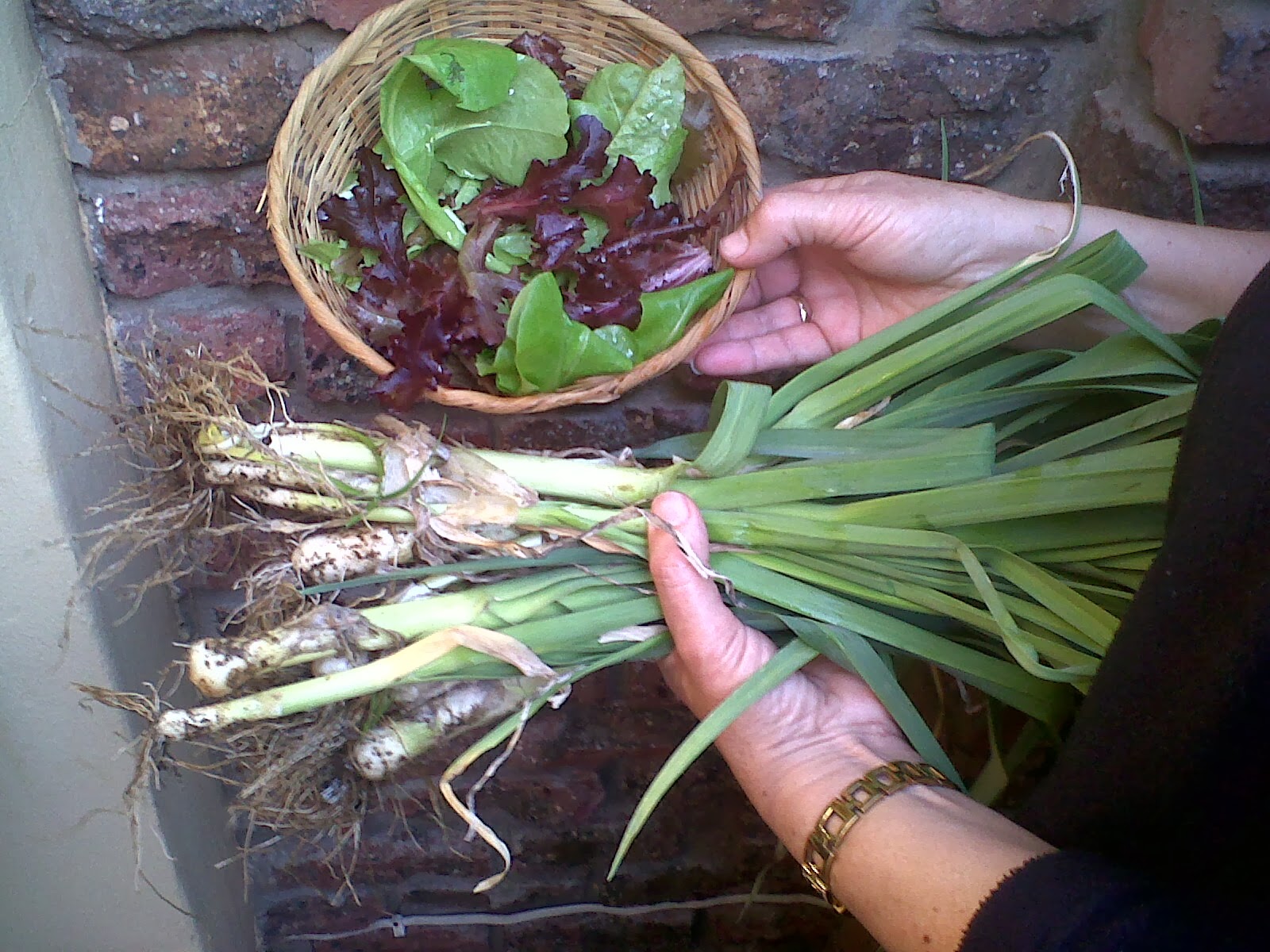
In addition to the parsley, leeks and lettuce were the other two members of the trio of top performers. Lovely green and purple lettuce bought at Norgarivier Nursery and planted in the beginning of October went into beautiful green salads. The leeks went into a gorgeous Leek, Bacon and Cheese Pie. The family couldn't get enough! Basically you pre-fry the leeks in butter, add it and grated cheddar, a carton of cream, a packet of half-cooked bacon and two eggs to a pie tin, in pastry, and voila! If you don't have enough leeks (like I did), sommer add a few normal diced onions to taste. Works like a charm.

Mid-Nov 2013 - Pole and bush bean harvest/Rank-en bosboon oes
Beans always perform well in our backyard garden, so I expected nothing less this year. This year I planted white pole beans, Contender bush beans and Lazy Housewife pole beans. In the photo, the larger, flattish beans on the left are the Lazy's and the thinner ones are the others. I got the organic Lazy's at Livingseeds - a highly recommended organic seed store. The white beans and Contenders I got from another kindly neighbour. 

We have already enjoyed all of them as green beans and some of them have been blanched and frozen. Now I can't wait for the bushes to perform even better, so the granny can make a decent batch of curried beans yummy!


I planted twelve red onion seedlings during the last week of May, and about the same number of Australian Browns the first week of June. The red onions performed quite well, but the white onions produced the smallest onions imaginable. We harvested them all the very end of November.
The lesson I learned from this comparison? Do not plant onions in hard-as-nails and compacted soil!

Hope I haven't bored you all with this lengthy post, but I guess someone out there might pick up a tip or two from my successes and failures. What do they say; practice makes perfect.