23 May 2014

Foreign Friday. Volksvreemde Vrydag

Tomatillos (Physalis philadelphica/Physalis ixocarpa)


When I bought my first tomatillo seeds a year ago (May 2013) I was very hopeful. It was the first seed I bought, and being a naive, first-time veg gardener I thought I would harvest a ton of green and purple tomatillos come summer. By March this year I was ready to pull the whole lot out. One miserable tomatillo. Hopes and dreams dashed.
Middle Feb 2014 - still hoping for any type of harvest
Middle Mar 2014 - hopes dashed...
... one miserable tomatillo harvested by Mid-March 2014
I really don't know what I did wrong with my tomatillos, but I have two theories. One; the sun scorched them, nestled up against the vibracrete wall. Two; the soil wasn't fertile enough. It's difficult to say which one of these theories is the correct one, or if it is a combination of the two. This is because I added tons of compost just as the weather cooled down slightly by the end of March.

In the gentler weather of April I started to notice a difference, and by middle May I had tomatillos everywhere:
15 May 14 - An abundance of green tomatillos!!!
15 Mei 14 - Groen tomatillos in oorvloed!!!
Now I was faced with another problem. You see, after I basically wrote off the tomatillos in March I had set this bed out for brown onions. Only brown onions. The granny told me April is the best month to plant onions in my neck of the woods. April came and went as I waited for the tomatillos to ripen, but by middle May I couldn't delay anymore. Yes, my tomatillos would've been bigger had I harvested them later, but onions are worth more in this household. You see, tomatillos are volksvreemd... onions not. So out went the tomatillos and in went the Texas Granos. 

This is what I harvested:
 
Maybe I should try a simple Salsa Verde recipe now. What do you think?

Botanical Name: PHYSALIS PHILADEPHICA or PHYSALIS IXOCARPA
Common Name: Tomatillo, Mexican tomato, husk tomato
Volksnaam: -
Native to: Mexico
Date planted/sowed: 10 + 18 Oct 2013
Ease to grow: Moderately easy to grow, but I had difficulties getting the plants to fruit
Costs: R11.00 for 35 seeds and about R20.00 for compost
Notes: Compost soil well two weeks before sowing tomatillo seed. Also avoid planting against hot, reflective walls.

9 May 2014

Backyard Farmer Contemplations. Agterplaas Boer Denke

As the autumn season draws nearer and nearer to a close, I thought it appropriate to reflect on my autumn garden. There isn't too much to show harvest wise, except the abundance of sweet potatoes, but let me share with you the goings on in my corner of the Garden Route:
Black Hungarian peppers and Bishop's Crown peppers/Swart Hongaarse en Klokvormige soetrissies
Bishop's Crown peppers in the backyard veg patch
Black Hungarian peppers in the backyard veg patch

Now that the weather is cooler but still warm, the peppers have come into their own. I think I got the green peppers too late in the season to produce, but the Bishop's Crown peppers have stolen the show. Such pretty vegetables, aren't they? Another pepper that has done really well (despite attempts at annihilation haha), is the Black Hungarian pepper. I got these critters from the kind folks at Organic Seed SA. The peppers turn a deep, glossy purple and is really quite mild. Even people who dislike hot food will love this one.
Tree Tomato/Tamarillo/Boomtamatie vruggies

What were only dainty little flowers on my Tree Tomato two short months ago, developed into plump fruits in the meantime. I can't wait to sample some of these fruits. Not only are they delicously strange and exotic, but they are also packed with vitamin A and C. I think they are a valuable and easy-to-grow addition to any South African garden.

Despite hectic berg winds, hail and the occasional downpour my autumn garden is coming along nicely. I hope to share the progress with you next time :-) 

5 May 2014

Cold Season Planting in South Africa. Koue Seisoen Tuinwerk in die Tuinroete

Okay, so I was a bit late with my cold season planting... I blame Murphy's Law. You see; not only was April my annual leave month, but I also visited Prince Albert and a few good friends in the Mother City. Time flew, and I got distracted, delayed... and dismayed! It was already middle-April and I didn't have any cold season crops in the soil. Neither seed nor plants. Oops! As my dreams of leek, kale, broad bean, radish and pea harvests started to go up in smoke, I decided to somehow make time and jump into the garden. Here is how that went:

The one good thing the delay in autumn planting caused is that the chicken manure I worked into my whole backyard veg patch and fruit bed had rested for more than a month. Ample time for it to reduce in strength so it wouldn't burn my little plants or seedlings. So with the composting and garden planning done (what felt like) ages ago I could get down to the fun part. I don't mean fun as in no sweat or hard work, but I always enjoy planting the most. It just feels the most productive for some reason.

The veg patch ready for sowing/Agterplaas gereed vir beplanting
On 17 April I planted young leeks I bought from the kind people at George Nursery and sowed Witkiem broad beans and Sugar Ann Snap peas sourced at the wonderful Organic Seeds, and also some radish seeds. The Black Palm/Nero di Toscana kale I sowed a day later, as I ran out of hours on the Thursday. I sourced the kale from the equally great site Livingseeds. I watered the seeds well and left the rest to wishful thinking and lots of prayers. You see, I was leaving for Cape Town a day later and the kind folks at the South African Weather Bureau were predicting torrential downpours. I had visions of rotten seeds and drowned seedlings instantly!

After the dismal summer harvests, I decided to plant a small selection of vegetables. Only the varieties that would work best. Or so I hoped. Therefore I decided to go with the Witkiem variety of broad bean; with the added bonus of rejuvenating my soil after the horrible blight-infested tomatoes. Sugar Ann peas looked like the best bet to me too and they have such a cute name, I just had to try them!

Kale was a different ball game altogether. I didn't know anything about kale until I read an article (or two) about it online. I don't even know the Afrikaans name, but I'm going for "Boerkool". Apparently it is the healthiest green vegetable you can possibly eat. It packs a punch in especially vitamin A and C (200% of the Recommended Daily Value) and also a ridiculous amount of vitamin K (over 700%), calcium and manganese. Not only will I therefore be able to enjoy a vegetable from my own garden, but I will be eating something with "potent anti-cancer properties", the ability to boost DNA repair and lower cholesterol. Bring it on, I say!

When I returned from Cape Town it was with trepidation. I already knew it rained more than 100mm in the space of three days. That's four inches of rain - more than some places get in a year! Oh no! I wasn't only pleasantly surprised with my little veg patch; I was delighted! Let me show you why:
Witkiem broad beans popping out/Witkiem boerbone wys hul gesig
Carentan leeks/Carentan prei plante
Black Palm kale making an appearance/Boerkool?
Cherry Belle radish/radyse
Sugar Ann Snap peas/Die erte maak hul verskyning
 Can anyone say; HUNDRED PERCENT GERMINATION RATE? I'm so chuffed with my little garden, and blessed of course! Now I'll just have to wait and see what bounty I get from it...

Which cold season crops did you plant this autumn?

16 April 2014

Growing Sweet Potato in the Garden Route. Patats in die Tuinroete

I haven't been posting as frequent as I want because I've been on leave for about a week now, as is normally the case in April. It's such a glorious month, don't you think? The milder weather, all those public holidays and to top it all off; my birthday. What could be better?

Another awesome April surprise was my sweet potato harvest. And boy, what a harvest it was! See, the whole "experiment" started last year mid-winter when my second mom gave me three medium-sized sweet potatoes to start slips with. Yes, I did my research! Unlike the normal potato, which is planted with a seed potato ('moer' in Afrikaans), the sweet potato is planted with slips - or basically stems that grow from a sweet potato lying in water. This is because potatoes are plants that form edible tubers whereas the actual sweet potato is a thickening of  its plant's roots, or that is how I understand it.

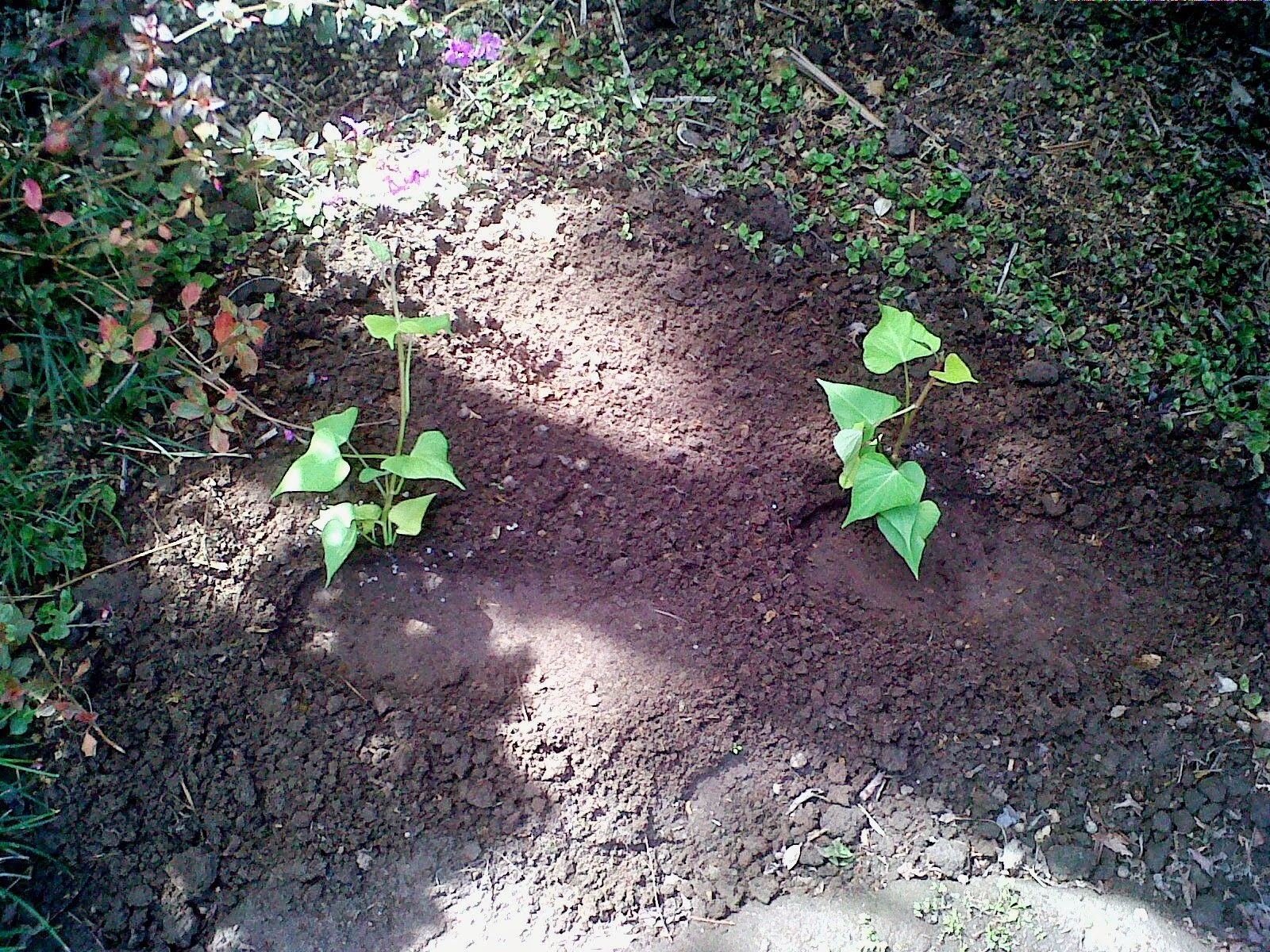
By the beginning of October my slips were ready to plant. You know this is the case when the slips are six inches long or more. Most will have roots on them as well. Simply break the slips off where they're attached to the potato and its ready to be planted. This is how my slips looked on 8 October 2013:
Slips started off from 3 sweet potatoes/Ranke wat met 3 patats begin is
Most of them went into the ground on the same day. Since I'm not blessed with limitless space, they had to go in between shrubs, conifers, between small fruit trees and even partially under the massive swamp cypress. 
Small cleared space for sweet potatoes between the grass, ground cover and conifers
The one thing all sources were in agreement with is that sweet potatoes (Ipomoea batatas) should be left in the ground as long as possible. This is due to the plant being native to tropical regions of Central and South America; therefore requiring warm nights and an average daytime temperature in the mid-twenties (centigrade). I decided I would leave my plants in peace until the beginning or middle of April, since March is still basically a summer month in my part of the Garden Route region. I could afford this luxury because I had planted the sweet potatoes so they could crawl into our normal garden, or just form a kind of green, living ground-cover for the soil in the fruit bed. They would therefore fulfill a dual purpose, because not only would I (hopefully) get to harvest some sweet potatoes, but the dense green foliage would help the soil retain moisture in the height of summer. Neat hey?
Sweet potato bed, instead of fruit bed?/Appel, laventel en kumquat skaars sigbaar tussen patatranke
The after photo (7 April 2014):
The fruit bed, sans sweet potatoes/Vrugtebedding na die patat-oes
Did the fruit bed deliver sweet potato-wise? Yes - over and over! I think it is the first thing I planted that wasn't just a success because it gave me pleasure to plant and harvest my own fruit and veg, but also a financial success... I actually put in way less than I got out. Wonderful!!!
Sweet potato harvest from the fruit bed/Patat-oes uit die vrugtebedding

How did the two slips planted six months before fare stuck between grass, ferns and conifers? Well:

Just as the sweet potato harvest was about to start/Nét voor die patats geoes is
Sweet potato harvest from conifer bed/Patat-oes uit conifer bedding
And so, from three average sweet potatoes I harvested 6kg six months later. I am amazed! This is clearly a vegetable I will plant over and over in my garden. Not fussy, no pests, minimal watering, big harvest. The only thing I noticed, once again, is that they shouldn't be planted in the shade. Partial shade is fine, although full sun (6h+ a day) leads to the highest yields. My biggest single sweet potato came from the sunniest part of the fruit bed. It weighed in at a respectable 750g... unfortunately I sliced it into pieces with the spade. Such is life.

26 March 2014

Soul Food: Pumpkin Fritters & Curried Beans. Sielskos: Pampoenkoekies & Kerriebone

I love food. I'm the first person to admit that, but for some reason I have an even greater passion for eating in the colder months. As soon as the leaves turn sunset shades of orange and yellow, I start to get hungry faster, nibble more and over-indulge on a (much more) regular basis. As per normal, the survival mechanism built into humanity since  cavemen days is  conveniently blamed for this turn of events.

I therefore thought it quite appropriate to write a blog post on soul food. Especially, two of my favourite recipes - both made from the bounty of my summer garden. I know, I know; "bounty" might be taking it too far, but here we go...

Pumpkin Fritters/Pampoenkoekies


Generally we Afrikaners view vegetables as something to sweeten and fatten up like a nice juicy chicken. Sugar and butter is added in very generous portions to most cooked vegetables and we subsequently brag to our English friends about our "healthy" diets... all them vegetables you see. This is naturally far from the truth, as the vegetables could just as well be dessert! Yes, I know there has been a trend towards healthier, raw or organic food in the last decade or so, but plain old traditional "Boerekos" (Afrikaner traditional fare; literally 'Boer food') still consist of a big portions of meat, two carbs (potatoes and rice of course) and normally two veggies - which is normally cooked with sugar and butter. I rest my case.
My mother's heavenly pumpkin fritters/Mamma se hemelse pampoenkoekies

Not that I'm anti-Boerekos! Oh no, this would be a dishonest and hugely ironic principle on my part, since "Pampoenkoekies" is my absolute favourite vegetable(-ish) dish. Let me share my aunt's easy recipe...

Pumpkin Fritter Recipe:

250ml finely mashed Butternut squash/fyngedrukte Botterskorsie
2 eggs/eiers
250ml cake flour/koekmeel
7ml baking powder/bakpoeier
15ml sugar/suiker
5ml lemon juice/suurlemoensap
1ml cinnamon/kaneel
a pinch of salt/'n knippie sout
sunflower oil/kookolie
cinnamon sugar/kaneelsuiker

Squeeze out excess water from the cooked and squashed butternut
Beat the eggs and add to the pumpkin, mixing it well
Add all remaining ingredients to the batter, except the oil or cinnamon sugar
Add spoonfuls of the batter into a pan with a bit of hot oil
Fry the fritters until bubbles appear at the top of each fritter, turn and bake on other side until golden-brown and done
Remove, place on kitchen towel and sprinkle each fritter with the cinnamon sugar.

Curried Beans/Kerriebone


One very sad thing about the current generation of younger adults (myself included) is that we are neglecting, forgetting and sometimes even losing the art of preserving. My maternal grandmother is a master at baking, cooking, making jam and preserving. I'm trying my utmost best to learn her secrets and observe her methods, but it's sometimes difficult jotting down recipes because she makes everything from memory and "... just add to taste..." How can one add Anything to taste if one has never made said thing?! Unfortunately (maybe fortunately?) the older generation simply didn't use recipes. Knowledge was passed from mother to daughter, and so the cycle was repeated.

One recipe I did manage to get out of the granny is her famous curried beans one. I've noticed that people overseas preserve their beans by pickling, but over hear in South Africa we simply adore our curried beans. Here is the recipe the granny uses:

Curried Bean Recipe:*
1kg grean beans/groenbone
2 big onions/groot uie
salt to taste/sout na smaak

Curry Sauce:
1 tbsp curry powder/eetlepel kerriepoeier
1 tbsp mild mustard powder/mosterd poeier
325ml vinegar/asyn
1 cup sugar/koppie suiker
2 tbsp corn flower/mielieblom

Mix all the sauce ingredients together well
Boil the beans until soft but still slightly crunchy, and then pour out all water
Pour sauce mix over beans and stir well
Bring the sauce and beans to a boil and remove from heat
Bottle the curry beans in sterilised glass jars when hot.
Grandma Baby's bottled curried beans/Ouma Baby se gebottelde kerriebone

Now I'm going to love and leave you... I'm off to enjoy a plate of soul food myself :-)
A mouth-watering plate of Boerekos/Heerlike bord Boerekos
* Rossouw, H. (1980) Huishoudkunde Handboek. Graaff-Reinet: H.Rossouw

12 March 2014

Autumn Backyard Garden. Herfs Agterplaas Tuin

My garden is in its transitional phase at the moment. Some summer vegetables are still producing, some are barely clinging on, most are dead, and I am itching to start planting autumn and winter veggies. 

Preparation is key to planting in any season, so I started by working over the bed where my butternuts were, and added some beautiful black gold. Yes, I did go for that turn of phrase because the alliteration has such a nice ring to it... Okay; the 'black gold' I'm referring to in this instance is chicken manure (chicken poo). I bought it at one of the only truly organic chicken farms in the Garden Route area; Red Barn. Go and check it out for yourselves people. The owner doesn't use any nasty antibiotics or chemicals and her chickens are free range in every sense of the word. The bed is nearly ready for the onions I will be planting there in April. I must still just pull out the miserable tomatillos and add some sand. This is how the bed looks now:
Chicken manure added to Onion Bed/Hoendermis by Uiebedding ingespit
 ... and this is why I said "miserable tomatillos":
My one and only tomatillo/Die som van my tomatillo oes
I can proudly say not everything is a miserable failure at the moment. Some plants actually still produce, even if the harvests are mostly meager. The star in my little Garden Route patch is still the pepino, as ever. I have also harvested volunteer cherry tomatoes constantly, but I can't take much credit for these. They are virtually indestructible! We are also enjoying the occasional bunch of Contender beans. The granny picked another 300g the day before yesterday, and we just had it in a gorgeous sweet curry with potatoes, cabbage, carrots, and meat yum :-)
Harvest:  450g pepino + 150g cherry tomatoes + 2x cucamelons
Let me take you on a quick tour of the rest of my garden...

The Delicious Monster starting to fruit/Vrugte aan die Monstera deliciosa
Our Delicious Monster (Monstera deliciosa) plant is clearly not past its fruit-bearing age, as I previously thought. I cannot wait for these babies to open up and ripen!

Cherry Guava covered in fruit/Klomp klein vruggies aan die Aarbeikoejawel
The little Cherry Guava/Strawberry Guava (Psidium cattleianum) tree is such a star. It has loads of little guavas, just 6 months after it last bore fruit.
 
Two hiding cucamelons/Die Mexikaanse Suurkomkommertjies kruip goed weg
I might have done exactly all the Wrong things as far as the cucamelons (Melothria scabra) go this year, but luckily I spotted a few small ones hiding behind dense leaf coverage. Yes, I will try them again later this year, and this time I will do it right!
 
Bell Peppers/Die klokvormige soetrissies begin dra
I have a suspicion these bell peppers might already be a strange hybridisation, as the granny used to grow all types of capsicums in close proximity. My motto: who cares, as long as they taste nice, hey?
 
Tamarillo flowers/Boomtamatie blommetjies
Since I bought my Tree Tomato (or tamarillo as Kiwi's call them) in May 2013 it has literally reached for the sky. The tree is now taller than my 6ft1, the leaves are humongous and yet I haven't picked one single fruit from it. Is this normal? I wouldn't know, but my granny certainly had a mouthful to say about it. I'm sure the words "pull out" have entered her mind. Luckily disaster seems to be averted, as I have spied some petite flowers up top. Is this a sign of juicy tamarillos to follow?
 
Another Black Hungarian Pepper/Nog 'n Swart Hongaarse Soetrissie aan't vorm
This will be the second little Black Hungarian Pepper to be harvested. It might have been more if I didn't accidentally destroy most of the plants. An honest mistake due to it looking suspiciously like yet More purple tomatillos... whoops!
 
Yet another ripe pepino/Nóg 'n boomspanspek is gereed om te pluk
Not much more to say about this one. Yes, the pepino is officially the gift that keeps on giving :-)
 

4 March 2014

Cold Season Garden Planning. Koue Weer Tuin Beplanning

I started avidly growing veggies in my backyard about 9 months ago, in the depths of 2013's winter. I was so eager to start, that I totally ignored the time of year and therefore got miserable results. Results which should have been expected, but nevertheless disappointing beyond belief. Yes, most new gardens are over-eager and make the fatal mistake of focusing on the vegetables/fruit trees/plants, instead of the soil. All the research I did beforehand warned me of this fact, so I had no excuse.

I won't make the same mistakes again, or I will at least try to improve on what I did wrong last year. Planning is one thing I'm very good at; sometimes so good that I plan and plan and plan, but never really implement. A character flaw I know. This is how the planning for my autumn and winter garden is coming along so far:

Calculating how much space you have

This was the logical first step for me, since the available space (and the type of space) will tell you the type and quantity of vegetables to plant. No simple task for me, as most of my space isn't square or rectangular beds, but have weirdly winding or circular edges. Blame my parents for their creative garden planning! For any other person this wouldn't be such a hassle, but I'm a sucker for precise calculations and mathematical formulae. Yes, I'm not only a garden geek, but a geek geek as well haha. After countless tries with a broken tape measure, pen and paper, and even calling in the help of a genial best friend (those damn formulae!) I had calculated my veg garden size to near precise dimensions. And so the real fun began...
 
Backyard Veg Patch - cold season crops to follow/Lappie vir herfs en winter groente

Deciding on which veggies or varieties to grow

The four factors which influence me on what to grow and where to plant it, are;
  • What do I like to eat? More specifically, what does my family like to eat?
  • What worked in my (or the granny's) garden before?
  • Which plants or vegetables benefit most from each other? (Companion Planting)
  • Which plants or vegetables are most suited to my soil type and amount of shade?

Drawing up a Garden Plan

This is one step that small-scale backyard gardeners don't have to spend too much time on. Being the kind of person that I am, I've spent hours and hours planning, calculating, drawing and re-drawing my very first Garden Plan(s).

I only have three spaces suitable to vegetables and the occasional fruit tree; they measure:
  • 6.1 sq meter (of which 4.8 sq meter can be used due to perennials)
  • 7.8 sq meter (of which 1.4 sq meter can be used due to shade and trees), and
  • 1.52 sq meter (all suitable for planting)
This leaves me with only about 15.5 sq meter. Not much by any stretch of the imagination, so therefore pre-planning is vital to optimise my space.

The most wonderful tool I've discovered online is the GrowVeg Garden Planner. Not only is it free for a 30-day period, but all features are available to users of the free trial programme! The first step in the design is to tell the programme the length and width of your bed. Then you simply choose a veg/fruit/flower type and plan out the rows or blocks desired. The nifty little programme will tell you automatically how many of said plant you can chuck into said space. Marvelous!

Here is an example of my backyard vegetable patch:
Backyard Veg Patch Plan/Agterplaas Tuinplan [copyright www.growveg.com]
See the full plan, all suggestions, and how wonderful this site really is at GrowVeg.com

Preparing the soil

As soon as the summer veggies and flowers start looking a bit straggly and production comes to a grinding halt, it is time to pull them out and either compost or destroy them, depending on whether they are still healthy specimens. This normally happens the last month of summer or in early autumn. In areas where chilly weather comes sooner (like the Free State or Gauteng) it would most probably be end Feb, and the Garden Route area where I live it's more likely to be March. There is no hard and fast rule to the month of the year though. 

From Pumpkin Patch to Onion Bed/Toekomstige wit-ui tuiste?
Now comes THE MOST IMPORTANT TASK IN GARDEN PLANNING... Soil preparation. It is very important to spend most of your available finances on preparing the soil well and the smallest amount on buying plants or seed. The type of soil you have is also very important. This is because you will need to add coarse sand to hard, clay soil or huge amounts of compost to loose, sandy soil. I have a mix of good garden soil and heavy, clay soil in my own garden.  

A rule of thumb is to add two bags of good, organic compost to a square meter of your garden. That is roughly equivalent to 2'' of compost (5cm) on top of your bed. It is also a good idea to add a complete fertiliser to your garden. 10-10-10 fertiliser is the best one to go with (equal amounts of nitrogen, phosphate and potassium). Manure is an alternative to compost, but must be well-rotted. A good indication on whether it is suitable for your veg patch is to smell it. If it doesn't reek to high heaven, it apparently is black gold!
A scattering of red onions to follow/'n Paar rooi uie midde-in die vrugte bedding?
All the preparation stuff must be done at least two weeks before any planting. I've just realised it's already March, and I haven't done even a square foot of soil preparation. I will definitely have to order a bakkie-load of compost from Norgarivier Nursery, some fertiliser... and get in my garden, sweating away!